

The Hidden Cost of Compensation Mistakes:
Why SMBs Struggle to Attract and Retain Top Talent
Small and medium-sized businesses (SMBs) face a critical challenge that can make or break their growth trajectory: developing an effective SMB compensation strategy. While larger corporations have dedicated HR teams and substantial budgets for competitive packages, small business hiring often involves guesswork, leading to costly mistakes that drive away quality candidates and create retention nightmares.
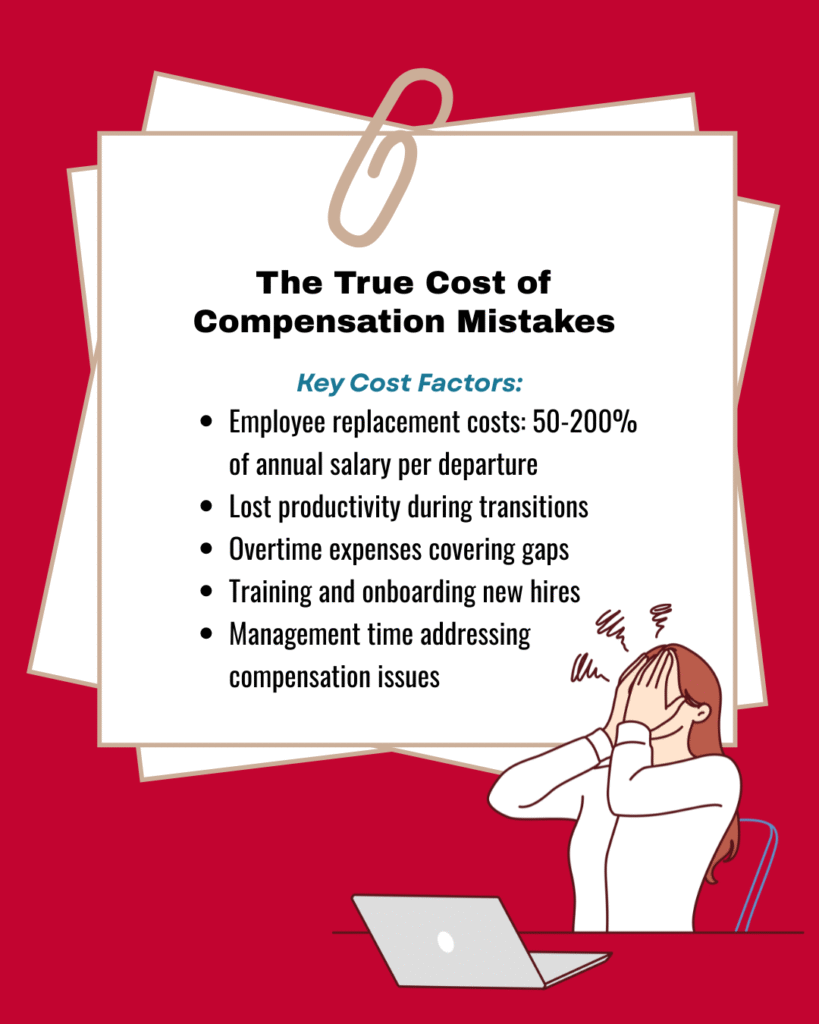
The talent war is real, and small and medium-sized businesses are fighting an uphill battle. While enterprise companies deploy sophisticated HR teams and unlimited budgets, SMBs often find themselves making compensation decisions on instinct rather than strategy. The reality is sobering: “Nearly half of SMB hiring managers cited meeting candidates’ salary expectations as their greatest hiring challenge” according to CPA Practice Advisor, December 2024. The result? A cascade of costly mistakes that not only drive away top candidates but create internal tensions that can fracture growing teams.
The reality is stark: compensation-related issues consistently rank among the top obstacles to small business hiring success. Yet most SMBs continue operating without formal SMB compensation strategy frameworks, hoping that passion for the mission will somehow compensate for structural pay problems. This approach inevitably backfires, creating expensive turnover cycles that drain resources and momentum exactly when growing companies need stability most.
The path forward requires understanding exactly where SMBs go wrong and implementing systematic solutions that work within realistic budget constraints. More importantly, it means recognizing when strategic partnerships with talent advisors can transform hiring from a recurring headache into a competitive advantage.
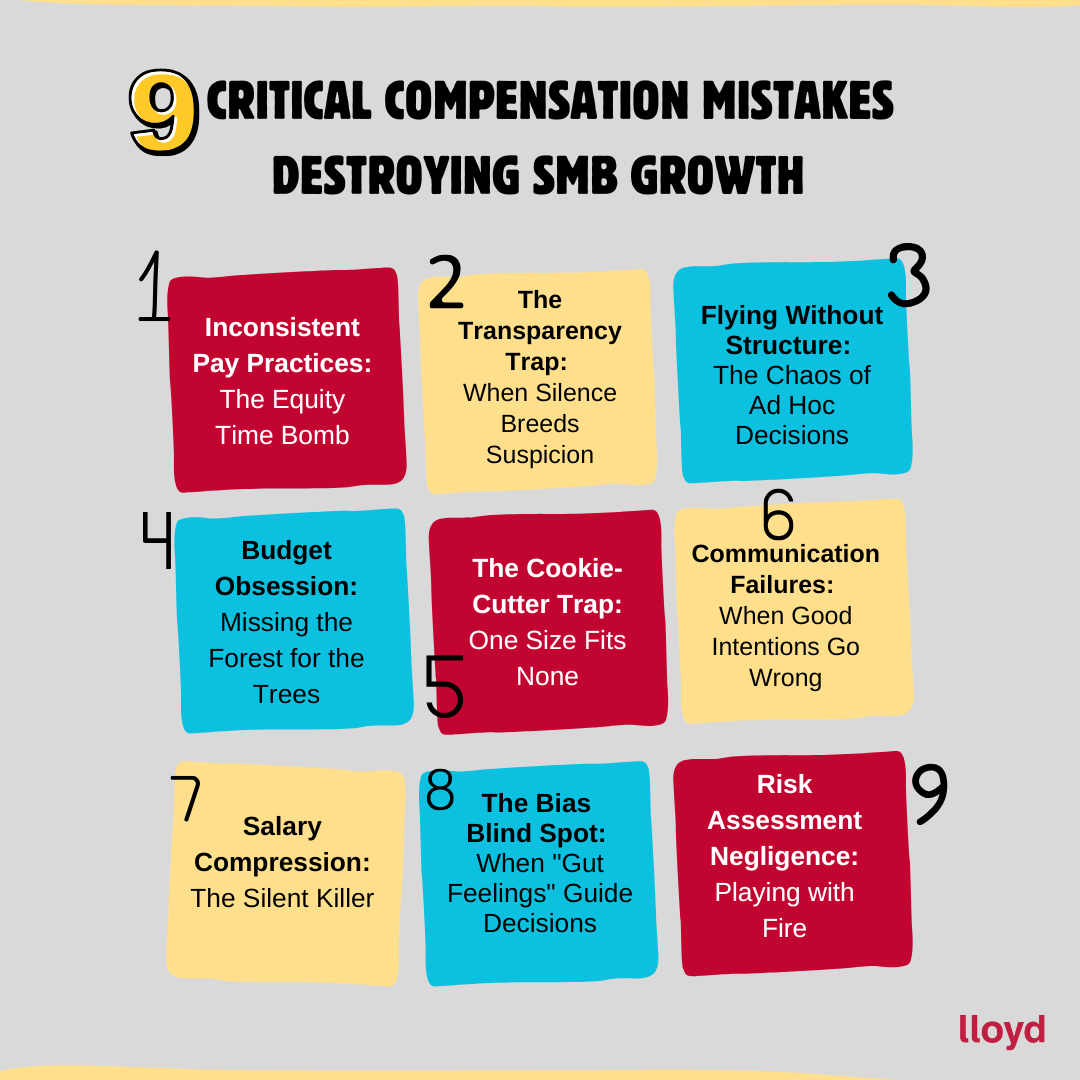
9 Critical Compensation Mistakes Destroying SMB Growth
- Inconsistent Pay Practices: The Equity Time Bomb
Perhaps no mistake proves more destructive to startup talent retention than inconsistent pay practices across similar roles. When SMBs lack clear compensation philosophies, they create patchwork salary structures that seem logical in isolation but become explosive when employees inevitably compare notes.
Imagine discovering that your colleague, hired six months after you with similar experience, earns 20% more for identical work. This scenario plays out daily in SMBs that make individualized pay decisions without considering broader equity implications. The immediate result is demoralization; the long-term consequence is talent exodus precisely when companies can least afford it.
- The Transparency Trap: When Silence Breeds Suspicion
Many SMBs believe that keeping compensation information confidential prevents internal conflict. The opposite proves true. When employees don’t understand how pay decisions are made, they fill information gaps with assumptions—usually negative ones. This lack of transparency erodes trust between management and staff, creating undercurrents of resentment that surface during performance reviews and career development discussions.
- Flying Without Structure: The Chaos of Ad Hoc Decisions
Operating without clear compensation structures turns every hiring decision into a reinvention exercise. SMBs without defined job levels and pay bands find themselves making emotional decisions under pressure, leading to offers that seem reasonable individually but create unsustainable precedents organizationally.
This structural absence makes budgeting nearly impossible. How can you plan growth when you can’t predict the cost of adding team members? How do you conduct meaningful salary reviews when there’s no framework for comparison?
- Budget Obsession: Missing the Forest for the Trees
Small business hiring managers often fixate on budget size while ignoring allocation efficiency. They’ll spend weeks negotiating whether they can afford $65,000 versus $60,000 for a critical role, then waste months managing the productivity gap created by hiring someone unqualified for that $5,000 savings.
This overemphasis on budget size rather than strategic spending creates false economies. The real question isn’t whether you can afford the right candidate—it’s whether you can afford to hire the wrong one.
- The Cookie-Cutter Trap: One Size Fits None
Treating all employees identically might seem fair, but it ignores the reality of diverse motivations and career stages. Your experienced sales manager values different compensation elements than your recent college graduate in marketing. Your remote developer prioritizes different benefits than your on-site operations coordinator.
SMB compensation strategy success requires recognizing these differences and building flexibility into your approach while maintaining overall fairness and consistency.
- Communication Failures: When Good Intentions Go Wrong
Even companies with solid compensation structures often fumble the communication piece. They make thoughtful, data-driven pay decisions but fail to explain the reasoning to affected employees. Without context, logical decisions appear arbitrary, and fair processes seem biased.
- Salary Compression: The Silent Killer
Market rates evolve faster than internal pay structures, creating situations where new hires earn more than experienced employees in similar roles. This salary compression destroys morale and forces companies into expensive retention battles with their best performers.
Competitive salary benchmarking helps prevent these situations, but many SMBs only check market rates when making new hires, not when reviewing existing employee compensation.
- The Bias Blind Spot: When “Gut Feelings” Guide Decisions
SMB leaders pride themselves on knowing their people, but this personal connection can introduce unconscious bias into compensation decisions. When pay determinations rely heavily on subjective judgment rather than objective criteria, inequities inevitably emerge—often along demographic lines that create legal and ethical concerns.
- Risk Assessment Negligence: Playing with Fire
Many SMBs operate compensation programs without understanding associated legal and compliance risks. From pay equity audits to overtime classifications, compensation mistakes can trigger expensive legal challenges that dwarf the cost of proper planning.
SMART SOLUTIONS
Implementing Your SMB Compensation Strategy Action Plan…
Being aware of the mistakes is key in transforming your hiring struggles into competitive advantages. Here are some proven strategies to put in place right now…
- Define Your Pay Philosophy Target specific market percentiles (50th, 75th) and stick to them consistently across all roles
- Build Simple Pay Structures Create job levels with salary ranges—complexity kills, simplicity scales with your growth
- Conduct Regular Market Reviews Competitive salary benchmarking quarterly prevents costly surprises and retention battles
- Communicate Transparently Share how pay decisions work without revealing individual salaries—trust beats secrecy
- Leverage Total Rewards Quantify benefits, growth opportunities, and flexibility—often worth more than salary differences
- Address Equity Proactively Regular pay audits prevent internal explosions when employees compare notes
The Value of Professional Guidance
Many SMBs discover that compensation challenges become more manageable with experienced guidance. “The average cost of hiring a new employee reaches almost $4,700 according to SHRM data“ as reported by Lano in 2025, making strategic hiring decisions even more critical.
Professional recruitment partners bring several advantages to small business hiring:
- Market Intelligence: Regular interaction with candidates provides real-time compensation data that internal teams often lack
- Positioning Expertise: Understanding how to present opportunities effectively against larger competitors
- Objective Analysis: External perspective can identify potential issues before they become expensive problems
Companies like Lloyd Staffing serve as strategic talent advisors, helping SMBs navigate compensation decisions while building sustainable hiring practices. This partnership approach often proves more cost-effective than learning through expensive trial and error.
Track What Matters
Monitor offer acceptance rates, time-to-fill, and retention by compensation quartile. Conduct annual equity audits and quarterly market reviews for key roles.
The Bottom Line
SMB compensation strategy doesn’t need unlimited budgets—it needs smart systems. “Replacing a departing employee can cost one-half to two times the employee’s annual salary” according to Built In, July 2024, making prevention through proper planning essential.
Companies that invest strategically in talent management consistently outperform those making reactive decisions. Whether building internal expertise or partnering with experienced advisors, the key is moving from ad hoc decisions to systematic approaches that support long-term growth. Lloyd’s President, Jason Banks, CSP , has a final word on this subject…

Watch the video “Renegade Hiring” Watch his Breaking Through the Talent Wall video on “Renegade Hiring.”
**************
Are you seeking an efficient and stable strategy for your talent needs?
Let Lloyd help you recruit and retain the most precise talent for your workforce.
Complete our Request Talent query to launch your search and we will have one of our Lloyd recruitment professionals reach out to you.
Are you ready to work with a recruiter who understands the community where you have established your career? Visit our Job Board to apply for one of our current searches.
**********
ABOUT THE AUTHOR
Nancy Schuman, CSP is the former Chief Commuications Officer for LLoyd Staffing.
A recruitment and career specialist, Nancy has more than 40 years in the staffing industry – 27 of them with LLoyd. Now semi-retired, she remains an advocate for career education; she has advised thousands of candidates on their resumes and job searches while also serving as the Careers columnist for a large weekly Long Island newspaper. Nancy has written 11 popular books for job seekers and business professionals. You can find her Author’s page and books on Amazon. She continues to blog for Lloyd and coach job seekers at all levels, offering advice for today’s competitive workplace.