

Two years ago, Lloyd Staffing shared our thoughts on talent density, the idea that a smaller team of top performers can outpace a larger, looser one. The logic was appealing, and plenty of companies took it to heart.
But the picture looks different now as 2027 approaches. Many of those same leaders tell us the org chart got smaller while the to-do list did not, and the people absorbing the difference are usually the ones the company can least afford to lose.
That is the slide from talent density to talent scarcity, and it is worth understanding before it shows up in your turnover numbers or your next missed deadline.
Density Wasn’t a Mistake. It Was Incomplete.
The thinking behind talent density still holds up. Surround strong performers with other strong performers and standards rise, problems get solved faster and decisions stop waiting in line.
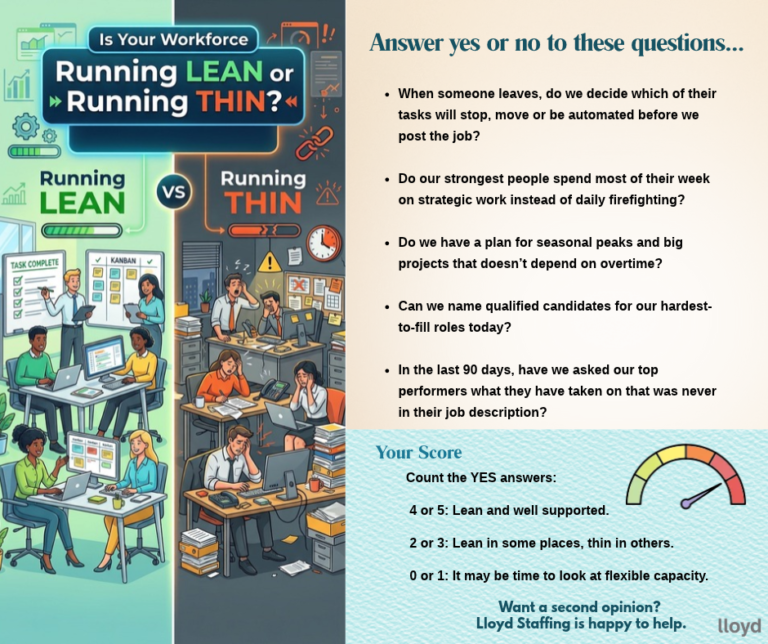
The trouble starts when headcount is cut and the work is not. Tasks don’t disappear along with the job title that used to own them. They drift upward to the dependable people who always say yes. Over time, a leader who was hired to think about next year is spending the day on this afternoon, and the company is lean on paper, but stretched thin in practice.
That is what talent scarcity often looks like inside a business. It is less a shortage of people in the world than a shortage of capacity in the seats that matter most. It also tends to hide itself. Output stays acceptable for a while because good people stretch, and that makes the strain easy to miss until someone resigns.
So, Is the Market Out of Balance?
The data suggests the problem has less to do with how many people are available and more to do with how they line up with the work.
In August, U.S. employers had about 7.1 million job openings, according to the Bureau of Labor Statistics. The September jobs report counted roughly 7.1 million unemployed people. On paper, that is close to one opening for every person looking. Yet employers added only 29,000 jobs in September, and hires in August came in at 5.2 million, well below the number of openings.
Meanwhile, people are staying put. The quit rate was 1.9 percent in August, a sign that many workers are holding on to the jobs they have. That can make the people employers most want to hire harder to reach, since they aren’t browsing job boards.
Employers feel the squeeze. SHRM’s 2026 Talent Trends research found that 68 percent of organizations are struggling to fill full-time roles. And stretched teams pay a price. Gallup reports that global manager engagement fell from 27 percent to 22 percent between 2024 and 2025, and estimates that low engagement costs the world economy about $10 trillion a year in lost productivity.
So it may not be a true imbalance of people and jobs. It looks more like a market that is out of sync, where the right person, the right role and the right moment rarely arrive together.
For employers, that distinction matters. If the problem were simply too few people, the fix would be to hire faster. When the problem is sync, the fix is workforce stability: knowing what work needs doing, who is doing it today and where the next pair of hands will come from.
5 Proven Ways to Stabilize Your Workforce
The middle ground does not mean going back to bloated org charts. It means designing the workforce on purpose, one decision at a time.
 Audit the work before you change the team. For every role you trim or leave open, decide which tasks will stop, which will be automated, which will move to outside support and which truly stay in-house. Eliminating a position without deciding what happens to its tasks simply moves the work to someone else’s desk.
 Protect focus time for your strategic people. Your best thinkers should be spending their hours on growth, not inbox triage. Block the time, push routine approvals down the chain and treat their attention like a line in the budget.
 Build a flexible workforce around a strong core. Seasonal spikes, system rollouts and major transitions rarely justify permanent headcount. Project-based, interim and temporary professionals can absorb that load while your core team stays focused on the work only they can do. A flexible workforce also gives you room to say yes to growth without committing to overhead you may not need in twelve months.
 Keep a warm bench. The slowest hire is the one you start after a resignation. Staying in touch with vetted candidates before you need them shortens the scramble, especially for the hard-to-fill roles.
 Make workload fairness visible. Retention follows realistic expectations, clear room to grow and a workload that doesn’t quietly pile onto the same few people. Ask your top performers what they have picked up lately that was never in their job description. The answer may surprise you.
What Job Seekers Should Know Right Now
For candidates, a lean market brings both opportunity and a few things to watch. Because many companies are keeping teams small, some job postings bundle duties that once belonged to two or three roles. That is not automatically a red flag, but it deserves questions.
Treat the interview as a two-way conversation. Ask how big the team is, who covers when someone is out, what the busiest quarter looks like and what support exists for the work. Employers who answer clearly are usually the ones who have thought it through. Then show how you prioritize, because that skill is in demand everywhere. Staying open to contract and project roles can help too. They are often how professionals build new skills and meet the people who later offer permanent positions.
If your search has run longer than you expected, you are in large company. BLS counted 1.9 million long-term unemployed people in September, about 27 percent of everyone out of work. This is a good moment to bring in a recruiter. A recruiter who knows the employers can tell you things a posting won’t: how a team really runs, what a role actually involves and whether your resume speaks the hiring manager’s language. They can also keep you in mind when something fitting opens up.
Where a Staffing Partner Fits In

Most leaders don’t need another vendor, and a good staffing partner shouldn’t act like one. They need a way to flex up and down without rebuilding the org chart every time the work changes. At Lloyd Staffing, that is the conversation we like to have: what is the work, what is the timeline and what kind of help fits? Sometimes the answer is interim leadership. Sometimes it is a project specialist for six months, or a direct hire to strengthen the core team.
A staffing partner can also be a sounding board before any hiring decision is made. Mapping out which work is steady, which is seasonal and which is a one-time project often shows that the answer isn’t simply “hire someone.” It is usually a mix, and getting the mix right is what keeps a team from sliding back toward scarcity.
Because Lloyd recruiters spend their days talking with candidates, they often know who is ready before a search officially starts. That head start is worth a lot when your best people are already running at capacity.
If your team is running lean or running thin, we are glad to talk it through. Employers can start at lloydstaffing.com, and professionals can browse open positions and connect with a recruiter there as well.
Lean can work. Lean without a plan is what wears people out. Give your core team room to do their best work, bring in flexible help for the rest, and talk openly about what the work really takes. That is where workforce stability starts.
Read more about STAFFING PARTNER COLLABORATION
If you’d like support assessing your workforce strength, our team at Lloyd Staffing is ready to talk.
Complete our Request Talent query to launch your search and we will have one of our Lloyd recruitment professionals reach out to you.
Could your job search use the support and resources of a Recruiter?
You can speak with industry experts and explore new industries.
Visit Lloyd’s Job Board to apply for one of our current searches.
**************
Nancy Schuman, CSP is the former Chief Commuications Officer for LLoyd Staffing.
A recruitment and career specialist, Nancy has more than 40 years in the staffing industry – 27 of them with LLoyd. Now semi-retired, she remains an advocate for career education; she has advised thousands of candidates on their resumes and job searches while also serving as the Careers columnist for a large weekly Long Island newspaper. Nancy has written 11 popular books for job seekers and business professionals. You can find her Author’s page and books on Amazon. She continues to blog for Lloyd and coach job seekers at all levels, offering advice for today’s competitive workplace.