
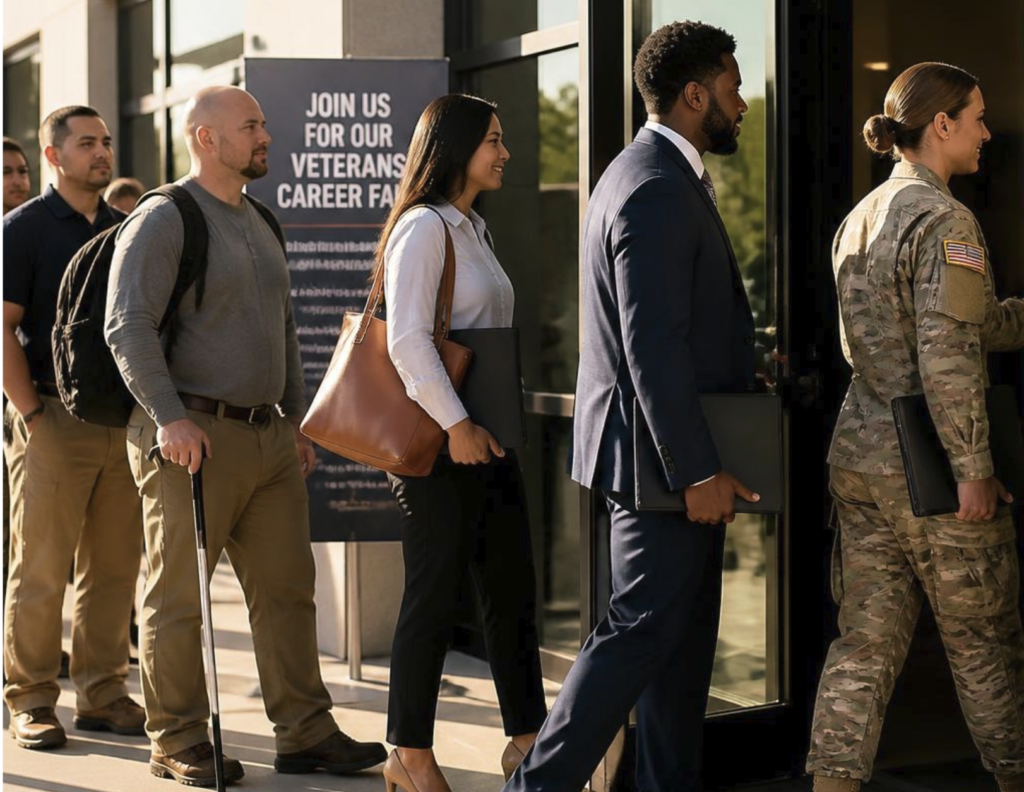
A veteran submits a resume online. Under experience it reads: “Squad leader. Twelve people, a million dollars in equipment, no room for error.” You’ll note the word “manager” appears nowhere. The company’s resume screening software may dismiss it before a single human reads a line, while somewhere across town a competitor’s live recruiter sees the very same resume, recognizes the potential and sends an interview invitation.
Nobody planned that outcome. Military language and civilian job postings barely overlap, and the first reader of a resume is frequently software, not a person. That is the core challenge of hiring veterans well. More than 8 million veterans were employed in 2025, and the employers who learn to read their experience get a first look at veteran talent other companies never see or consider.
As Veterans Day approaches, it’s a good moment to talk about hiring veterans: what the newest numbers show, where employers still get it wrong, and how AI is changing the translation problem for both sides of the hiring desk.
THE NUMBERS BEHIND YOUR NEXT HIRE
Let’s start with the headline. The Bureau of Labor Statistics reports that veterans averaged 3.5% unemployment in 2025, compared with 4.2% for nonveterans. Of the nation’s 17.26 million veterans, 8.04 million were employed. Veteran unemployment was 3.5% again in September 2026, compared with 3.9% for nonveterans, according to the latest monthly BLS figures available at the time of this writing.
Nearly 45% of employed veterans work in management or professional occupations. In management, business and financial operations, veterans account for 22.3% of employed veterans, compared with 19.0% of nonveterans. Women make up 12% of veterans, and approximately 59% of employed female post-9/11 veterans work in management or professional occupations, compared with roughly 49% of nonveteran women. This is veteran talent with real leadership experience, not candidates waiting for an entry-level shot.
Here’s a number that should make private employers take notice: about one in six employed post-9/11 veterans works for the federal government. Among nonveterans, it is closer to one in fifty. Government has a head start on this talent, and you can close the gap by showing up where veterans look, in language veterans recognize.
One more finding is worth thinking about. Half of post-9/11 veterans reported a service-connected disability in August 2025. Yet veterans with a service-connected disability had a lower unemployment rate (2.4%) than those without one (3.7%). If your instinct says “hard to place,” test it.
 And if you hire on Long Island, Suffolk County is home to approximately 48,000 veterans, the largest veteran population of any county in New York State.
YOUR SCREENING FILTER ONLY SPEAKS CIVILIAN
Military roles come with their own vocabulary, and civilian job postings come with another, which makes the military-to-civilian transition harder than it needs to be. A logistics sergeant may have managed inventory, forecasting and vendor coordination at serious scale, but if the title doesn’t match your keywords, the resume may stop at the filter. Those transferable skills only count if something, or someone, can see them.
Try this test. Take a real veteran resume, run it through your own application process, and see whether it reaches a person. If you don’t like the answer, you’ve found the fix.
ESSENTIAL MOVES FOR A STRONGER VETERAN HIRING STRATEGY
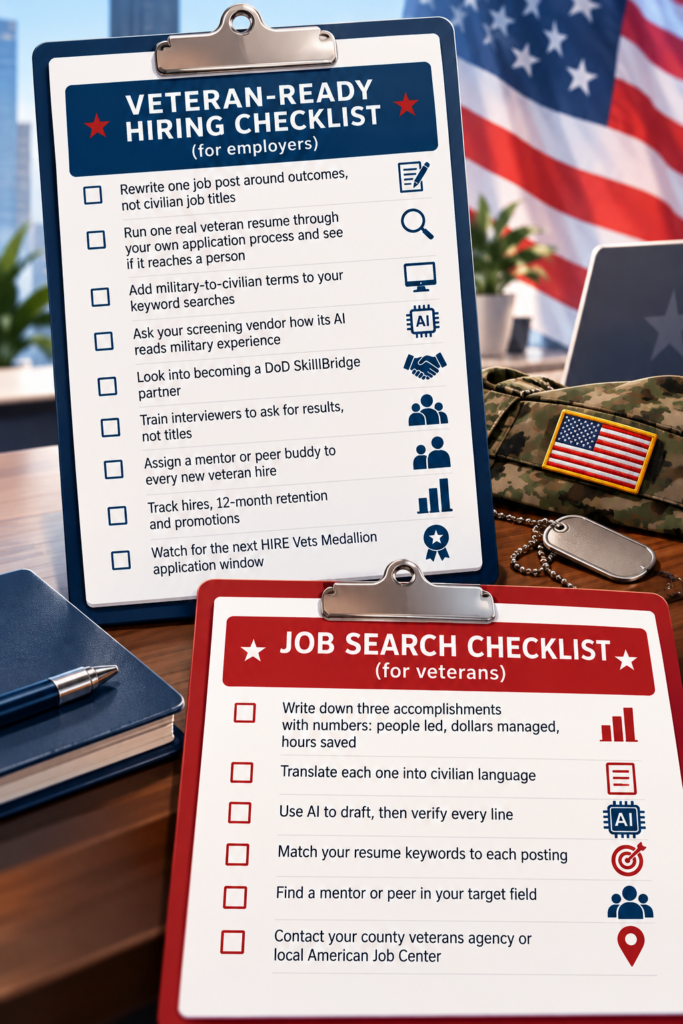
- Rewrite a current job post. Cut requirements that only describe a civilian career path, such as “five years as a department manager,” and describe the results the role owns. Everyone, veteran or not, reads a post like that more clearly.
- Recruit where veterans already are. Among the best veteran employment resources, DoD SkillBridge allows eligible service members to participate in approved civilian training and work-based learning opportunities during their final 180 days of military service, subject to service-specific limits and command approval. Participants continue receiving military pay and benefits while employers provide training, supervision and workplace experience. Employers interested in hosting participants must complete the DoD approval and agreement process before participation begins.
One caution: The Work Opportunity Tax Credit (WOTC) expired on December 31, 2025, and remains in a federal authorization hiatus as of this writing. Employers should check the Department of Labor’s WOTC page for current status before counting on the credit.
- Interview for what they did. Ask about leading a team through a change they didn’t choose, or running a process with too few resources. Let candidates translate in their own words, and describe the role’s real challenges so they can draw the line themselves.
- Onboard on purpose. Whether your team works in an office, remotely or somewhere in between, set clear expectations, assign a mentor, give regular feedback, and connect new hires with a peer network or employee resource group. The first months set the tone for whether a good hire stays.
- Measure what happens after the offer. Track applications, interviews, hires, retention and promotions. A record 888 employers earned the 2025 HIRE Vets Medallion from the Department of Labor. The 2026 application window closed April 30, so watch for the next one.
WHERE AI CHANGES THE MATH
AI now sits on both sides of the hiring desk, and for employers the risk and the opportunity are the same tool. AI-assisted screening can help surface transferable skills a keyword search might miss, but it can also overlook them. Ask your vendors how their tools read military experience, keep a person reviewing the results, and check the employment rules that apply to you, including applicable state and local laws governing automated employment decision tools.
For veterans, AI works well as a translator. Paste in a job posting and your own list of responsibilities, then ask for civilian equivalents. A logistics sergeant might find that “supply accountability” reads as inventory control and asset management. The rule is simple: use AI to communicate your experience, never to invent it. Verify every line, and keep classified or sensitive operational details out of public AI tools.
Veterans who want to add technology skills have help, too. VetsinTech is a nonprofit that connects veterans and military spouses with technology education, career opportunities and employer connections.
MAKE VETERAN TALENT PART OF YOUR WORKFORCE STRATEGY
Veterans Day is one day on the calendar. Recognizing and developing veteran talent should be an ongoing commitment.
Employers can start by evaluating skills more broadly, expanding recruiting channels and creating opportunities for veterans to contribute and advance. Veterans can take the next step by translating their experience into civilian business language, highlighting accomplishments and using available career resources.
At Lloyd Staffing, we connect organizations with talent across Accounting and Finance, Business Support and People Operations, Healthcare, Information Technology, Life Sciences, Marketing and Creative, and Supply Chain. Whether you are building a team or planning your next move, the right conversation can open new doors.
Employers: Explore how Lloyd Staffing can support your veteran hiring strategy.
Job seekers: Explore opportunities.
MORE LLOYD ARTICLES – Related reading
Veteran Hiring Strategy
Written by Nancy Schuman, CSP, the former Chief Commuications Officer for LLoyd Staffing.
A recruitment and career specialist, Nancy has more than 40 years in the staffing industry – 27 of them with LLoyd. Now semi-retired, she remains an advocate for career education; she has advised thousands of candidates on their resumes and job searches while also serving as the Careers columnist for a large weekly Long Island newspaper. Nancy has written 11 popular books for job seekers and business professionals. You can find her Author’s page and books on Amazon. She continues to blog for Lloyd and coach job seekers at all levels, offering advice for today’s competitive workplace.