

By Nancy Schuman, CSP | Talent Strategy for Growing Businesses
Here is an uncomfortable truth for many small and mid-sized business leaders: the best candidates are not sitting at their desks refreshing job boards, waiting for your opening to appear. They are employed, modestly satisfied, and open to a conversation — but only the right one, delivered the right way. If your hiring strategy still relies on posting and praying, you are not competing for top talent. You are competing for whatever is left.
This is the new reality of talent acquisition, and it hits SMBs particularly hard. Larger organizations have dedicated recruiting teams, strong name recognition, and employer branding budgets. Smaller businesses often have none of these things — and in a tight labor market, that gap is costing them more than they realize.
Let’s look at where the breakdowns are happening, and more importantly, what you can do about them.
The Candidate Has Changed — Has Your Hiring Process?
According to LinkedIn’s 2024 Global Talent Trends report, 70% of the global workforce is made up of passive talent — people who are not actively job hunting but would consider the right opportunity. Yet most SMBs exclusively fish in the active talent pool: people who are unemployed, urgently looking, or dissatisfied enough to scroll job boards on their lunch break.
That other 70%? They need to be found, cultivated, and persuaded. They will not be clicking ‘Easy Apply’ on your Indeed posting.
Meanwhile, even among active candidates, expectations have shifted. A recent Talent Board study found that 58% of job seekers have declined an offer or abandoned an application due to a poor candidate experience. (That experience starts from the first touchpoint — and for many SMBs, that touchpoint is doing quiet damage.
Where SMBs Are Losing Good Candidates Before They Even Start
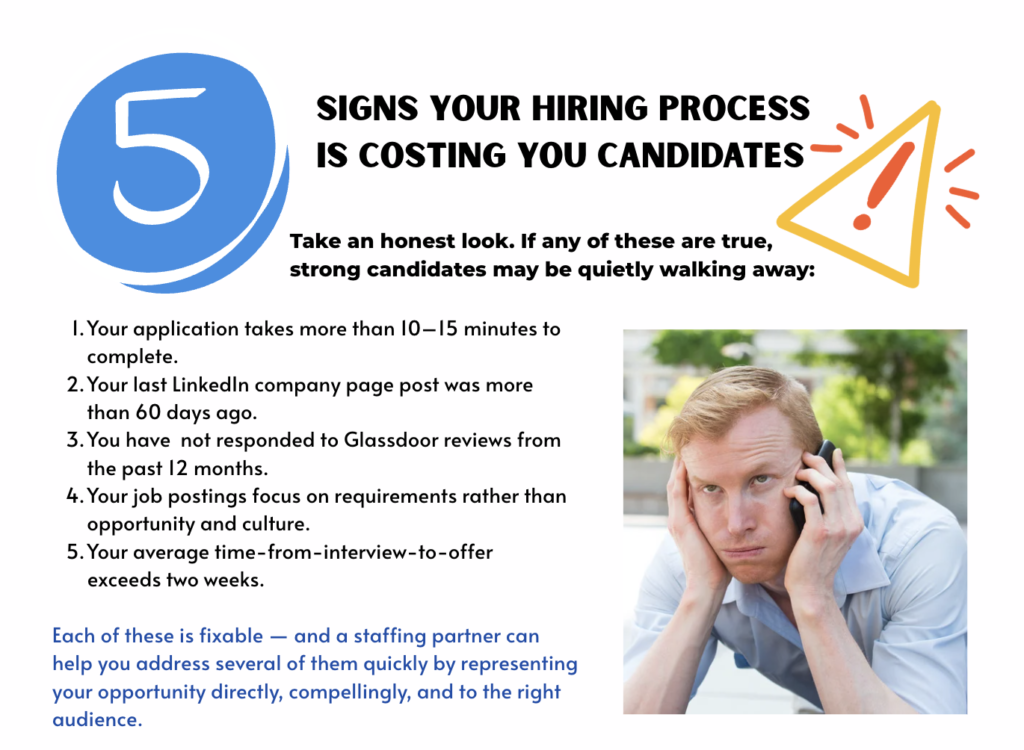
The friction points are real, and they compound. Here are the most common places strong candidates quietly disengage:
Cumbersome application processes.
If your application requires account creation, a lengthy questionnaire, or a résumé upload followed by manually entering the same information, you are losing candidates. Research from SHRM indicates that application processes taking longer than 15 minutes result in a measurable drop-off in qualified applicants. Candidates with options — the ones you want — will simply move on.
Poorly written job postings.
Vague responsibilities, inflated requirements, and corporate jargon signal a company that has not thought carefully about what it actually needs — or about the person it is trying to attract. A job posting is a first impression and a marketing document. If it reads like a task list, it will attract transactional applicants. Equally damaging is the omission of salary information. Research from LinkedIn shows that job postings that include compensation ranges receive significantly more applications — and stronger ones. Candidates who are currently employed and selectively evaluating opportunities will rarely pursue a role that withholds pay, interpreting the silence as either below-market or evasive. In a competitive talent market, transparency about compensation is not just courteous — it is strategic.
No visible employer brand or identity.
Strong candidates research you before applying. They check your website, your LinkedIn page, your social presence. If what they find is sparse, outdated, or inconsistent, they draw their own conclusions — usually unflattering ones. According to LinkedIn, companies with a strong employer brand see 50% more qualified applicants and reduce their cost per hire by up to 50%.
Neglected social media presence.
Your social channels are not just for customers. Candidates are watching to see if your culture looks real, whether leadership is visible and credible, and whether your company appears to be growing or stagnating. A dormant LinkedIn page or a Facebook feed that has not been updated in eight months says a great deal — none of it reassuring.
Negative reviews on Google and Glassdoor.
According to a 2023 Glassdoor survey, 86% of job seekers read company reviews before applying. Unaddressed negative reviews — particularly those mentioning management, communication, or turnover — are dealbreakers for the most discerning candidates. You do not need a perfect rating. You need to be present in the conversation.
Slow or opaque hiring timelines.
In a candidate-driven market, a two-week gap between interview and offer is a gap in which another employer closes the deal. Candidates interpret silence as disorganization or disinterest. Either way, it causes them to disengage.
The Strategic Shift: From Posting to Pursuing
The most effective hiring strategies for small businesses today are not reactive — they are proactive. They involve passive candidate recruiting, accessing talent before it becomes available, building relationships before a need is urgent, and positioning the opportunity compellingly to candidates who were not looking for it.
This is where a staffing partnership changes the equation entirely.
Think of a good staffing partner not as a vendor who fills requisitions, but as your talent ambassador in a competitive market. Their job is to represent your company — your culture, your growth story, your opportunity — to candidates who are selectively listening and highly skeptical of generic outreach. That representation requires credibility, relationships, and skill. It is not something a job board can replicate.
Here is what that looks like in practice:
Access to passive talent. Staffing firms maintain active networks of professionals who are not publicly job hunting. These candidates are often among the strongest in the market precisely because they are employed and not desperate. A recruiter’s outreach to a passive candidate carries a different weight than a job posting — it signals that they were specifically identified, not just one of many applicants. Research from LinkedIn shows that passive candidates are 120% more likely to make a strong impact when hired.
Pre-selling the opportunity. Recruiters do not just match résumés to job descriptions. They have genuine conversations. They learn what a candidate values, address hesitations, and contextualize the opportunity in a way that is specific and persuasive. When a recruiter calls on your behalf, the candidate hears: ‘Someone thought enough of your profile to specifically reach out.’ That changes the conversation.
Real-time market intelligence. A staffing partner who is active in your sector knows what candidates are being offered by your competitors, which skill sets are scarce, and what compensation expectations currently look like. This intelligence is often the difference between making an offer that lands and losing a finalist to a faster, better-informed competitor. According to the Bureau of Labor Statistics, certain technical, healthcare, and finance roles are seeing candidate-to-opening ratios as low as 0.5 — meaning there are more open positions than available candidates. (without real-time data, you are navigating blind.
A pipeline, not just a placement. The best staffing partnerships are ongoing relationships. A good firm is not just filling today’s need — it is building a bench of pre-qualified talent for tomorrow’s. For growing SMBs, this kind of advance preparation is the difference between scaling smoothly and scrambling.
Contract Talent and the SMB Workforce
There is another dimension to this conversation that deserves attention: contract staffing as a deliberate workforce strategy, not a stopgap.
SMBs are increasingly using contract and project-based workers to protect budget flexibility, accelerate time-to-hire, and bring in specialized skills for finite needs. According to Staffing Industry Analysts, the U.S. temporary and contract staffing market reached $196 billion in 2023, reflecting a sustained shift in how businesses of all sizes structure their workforce.
For SMBs, the appeal is practical: you can engage a highly skilled professional for a defined project without the full-time cost commitment, test the fit before extending an offer, and build workforce capacity faster than a traditional hire allows. When a particular skill is scarce — advanced data analytics, specialized compliance expertise, niche software development — competitive compensation for contract work often attracts talent that would be cost-prohibitive at a permanent rate.
A staffing firm is essential to this strategy. They maintain a vetted pool of contract professionals across disciplines, can match you with qualified candidates in days rather than weeks, and handle the administrative complexity of contingent hiring. The result is a more flexible, cohesive workforce that can respond to business demands without overextending permanent headcount.
Where Lloyd Comes In
Lloyd has been helping SMBs across the Northeast, as well as nationwide, build strong, flexible teams for decades. We specialize in direct hire, contract, and contract-to-hire placements across professional, digital, technology, finance, and supply chain sectors. What distinguishes our approach is not just the depth of our candidate network — it is the way we engage on your behalf. We take the time to understand your culture, your growth trajectory, and what makes an opportunity at your company genuinely compelling. Then we bring that story to candidates who would never have found you on a job board. Think of us as an extension of your team — one whose job is to make sure the right talent finds you before your competition does.
Assembling Your Best Team Starts with an Honest Audit
If the talent standoff is real — and it is — then staying the course with a purely inbound, post-and-wait hiring strategy is not neutral. It is a choice to compete for a smaller and less experienced slice of the candidate market.
The businesses assembling the strongest teams right now are those that have recognized this shift and adapted. They are investing in their employer presence, tightening their candidate experience, leveraging contract talent strategically, and working with partners who can reach the talent that will never come to them.
The hiring strategies for small businesses that work in today’s market are proactive, relationship-driven, and data-informed. Whether your next hire is permanent or contract, immediate or planned, the edge goes to the employer who treats talent acquisition as a strategic function — not an administrative one.
Your next great hire is out there. They are just not looking for you… yet.
************************************
Are you in need of hiring support?
Let us help you find the right person for your role. Hire Now.
Are you working, but unsatisfied and ready for a new role?
Visit our Job Board to apply for one of our employment opportunities.
************************************
ABOUT THE AUTHOR

Nancy Schuman, CSP is the former Chief Commuications Officer for LLoyd Staffing.
A recruitment and career specialist, Nancy has more than 40 years in the staffing industry – 27 of them with Lloyd. Now semi-retired, she remains an advocate for career education; she has advised thousands of candidates on their resumes and job searches while also serving as the Careers columnist for a large weekly Long Island newspaper. Nancy has written 11 popular books for job seekers and business professionals. You can find her Author’s page and books on Amazon. She continues to blog for Lloyd and coach job seekers at all levels, offering advice for today’s competitive workplace.