

The hiring conversation keeps changing — and not quietly. For years, employers relied heavily on traditional degrees as the gold standard for evaluating talent. In 2026, a more nuanced currency is gaining traction: microcredentials and the microskills they represent. In fields like AI, technology, creative services, professional operations, finance, supply chain, and even sales, employers are increasingly prioritizing what candidates can do right now over where they spent four years in school. These shifts reflect some of the most significant hiring trends of the decade.
This shift isn’t about dismissing higher education. It’s about recognizing that the modern workforce evolves faster than most traditional programs can keep pace. Academic learning can become dated quickly. For employers competing in tight talent markets, the ability to identify verified, hands-on skills has become a strategic advantage — and a growing reason many turn to specialized search partners to help interpret the signal from the noise.
 Way #1: Microcredentials Are Creating a New Hiring Currency
Microcredentials — sometimes called digital badges or nano-degrees — have emerged as a powerful alternative and complement to traditional degrees and certifications. Unlike lengthy educational programs, microcredentials offer focused, bite-sized learning opportunities that target specific skills and competencies.
Here’s what sets them apart:
- Affordability
- Flexibility
- Direct relevance to in-demand roles
Job seekers can acquire targeted skills aligned with industry needs, making them more competitive for the current workforce. Employers, in turn, value microcredentials as a tangible demonstration of an individual’s commitment to continuous learning and adaptability.
The data backs this up. According to Coursera’s Micro-Credentials Impact Report 2025, 96% of employers believe microcredentials strengthen a candidate’s job application, and 90% are willing to offer higher starting salaries to candidates with recognized, credit-bearing microcredentials, which was substantiated by Inside Higher Ed. Meanwhile, the World Economic Forum predicts that 59% of workers will require retraining by 2030 as technological disruption and AI integration transform the global labor market.
In short: the market is moving, and fast.
 Way #2: The Microskills Economy Is Redefining Day-One Readiness
If microcredentials are the currency, microskills are the underlying asset. Microskills refer to highly specific, demonstrable capabilities — think prompt engineering for AI tools, advanced Excel automation, Figma prototyping, demand forecasting, or CRM workflow optimization. These are the practical, immediately deployable skills that drive productivity on day one.
Technology cycles are shortening. Roles are becoming more hybrid. Teams need contributors who can ramp quickly. Project-based work is expanding. In fields like AI and tech especially, the half-life of knowledge is shrinking. A four-year degree completed five years ago may not reflect current capability. A recent, verified microcredential in a current toolset often does. The WEF’s 2025 Future of Jobs report found that 63% of employers cite skills gaps as the biggest barrier to business transformation.
 Way #3: They’re Transforming Hiring Across Key Talent Markets
AI and Technology
In AI, data analytics, cybersecurity, and cloud environments, microcredentials have become particularly influential. According to Coursera, 92% of employers say they are more likely to hire a candidate with a GenAI microcredential than one without, and in 2024, a learner enrolled in Coursera’s GenAI courses every 10 seconds. This is a remarkable signal of where both supply and demand are headed. Employers increasingly look for verified skills in machine learning frameworks, prompt engineering, cloud platform administration, and Python and automation tools. Because these domains evolve rapidly, microcredentials provide a more current snapshot of capability than many legacy credentials.
Creative and Digital Roles
Creative teams have long prioritized portfolios, but microcredentials and digital badges are adding another layer of validation. Certifications in UX design, motion graphics tools, marketing automation platforms, and content analytics help hiring managers confirm both technical fluency and commitment to staying current. For employers, this reduces risk. For candidates, it signals professional momentum.
Project Management
Microcredentials have become especially valuable in Agile environments. Agile project management certifications in Scrum, Kanban, and Lean equip individuals with practical frameworks needed to drive successful initiatives — and enable project managers to stay current as methodologies evolve, a critical advantage in organizations where speed and adaptability matter.
Finance, Supply Chain, and Sales
Even traditionally degree-heavy functions are seeing movement. Finance teams increasingly value microcredentials in financial modeling tools, automation platforms, and data visualization. Supply chain leaders look for certifications in logistics analytics, ERP systems, and demand planning tools. Sales organizations are embracing credentials in CRM optimization, sales enablement platforms, and revenue operations. The common thread: measurable, applied capability.
 Way #4: They’re Challenging the Four-Year Degree as the Default Filter
Let’s be clear — the four-year degree is not disappearing. However, its role is evolving. Many employers are shifting toward a “degree-plus-skills” or even “skills-first” mindset, particularly for technical roles, creative positions, project-based work, mid-career hires, and contract and freelance talent. Skills-based hiring is no longer a fringe concept — it’s becoming standard practice.
Research from the Harvard Business School Opportunity Project has documented the rise of skills-based hiring, noting that many roles historically requiring degrees can be performed effectively by candidates with alternative credentials and relevant experience. And the shift is gaining real momentum: LinkedIn/HR Panda data shows 85% of employers say they are prioritizing skills over degrees. What’s happening is less a rejection of higher education and more a recalibration of priorities. Employers are asking: Can this person perform the work? How quickly can they contribute? Do they demonstrate continuous learning? Microcredentials help answer those questions — but they also introduce a new challenge.
 Way #5: They’re Exposing a New Form of Resume Inflation
As the market expands, credential quality varies widely. Employers now face a new form of resume inflation: badge overload, unverified programs, minimal hands-on rigor, and outdated coursework. A digital badge alone does not guarantee real-world capability. The signal can be strong — but only when properly validated. This is also where experienced search partners bring measurable value.
 Way #6: They’re Delivering Measurable Returns for Employers and Candidates
Coursera’s Micro-credentials and the Future of Talent reports compelling data for both sides of the hiring equation.
For employers:
- Microcredentials offer a tangible demonstration of an individual’s commitment to continuous learning and adaptability.
- 91% of employers believe entry-level employees with microcredentials demonstrate higher proficiency in essential job skills.
- 92% note that graduates with microcredentials have skills that can be immediately applied on the job.
For candidates:
- 28% of entry-level workers with microcredentials reported receiving a pay raise, and 21% received a promotion after earning one (as confirmed by Inside Higher Ed).
- Forward-thinking companies are also using microcredential programs internally to upskill existing staff, close emerging skills gaps, improve retention, and build more agile teams.
Successful programs typically share three characteristics:
- Industry alignment — collaboration between educational institutions, industry experts, and certification providers to address real skills gaps.
- Hands-on application — the strongest programs incorporate practical experiences that allow learners to apply knowledge in real-world scenarios.
- Accessibility — ensuring programs are available to learners of diverse backgrounds regardless of prior education level, which expands the available talent pool.
 Way #7: They’re Raising the Bar for How Talent Partners Evaluate Candidates
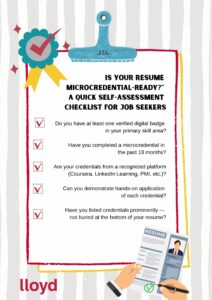
As hiring trends continue to shift toward skills-based models, identifying true capability requires more than keyword scanning. We see the power of microcredentialing and digital badges and how they are affecting hiring decisions. We also see where they genuinely predict
success versus where they simply decorate a résumé.
At Lloyd, candidate evaluation goes well beyond credential spotting. Our approach to pipeline development focuses on pinpointing hands-on skills, validating real-world application, and assessing culture alignment — the factors that ultimately determine whether a hire succeeds. Our vetting process may include deep-dive candidate interviews, portfolio and work sample reviews, skill verification conversations, culture and team-fit assessment, and when appropriate, finalist project challenges using designated skills.
From our perspective at Lloyd, microcredentials and microskills are not a passing trend. They represent a structural shift in how capability is learned, demonstrated, and evaluated. For job seekers, they offer faster, more flexible pathways to relevance. For employers, they provide a more current view of workforce readiness. For organizations navigating tight labor markets, they create new opportunities to widen the talent lens. But as with any emerging signal, interpretation matters enormously. The companies that will win the next phase of the talent race won’t simply collect more résumés — they’ll get better at reading what truly predicts performance. That requires sharper tools, stronger partnerships, and the discipline to distinguish real capability from loud credential noise.
*********
Are you in need of recruitment support to help solve your organization’s hiring challenges? Does microcredentialing fit into your strategy?
Let us help you devise a plan for incorporating such skills into your recruitment plan. Hire Now.
Are you working, but unsatisfied and ready for a new role? Have you become certified and/or credentialed in new skill areas?
Visit our Job Board to apply for one of our employment opportunities.

ABOUT THE AUTHOR
Nancy Schuman, CSP is the former Chief Commuications Officer for LLoyd Staffing.
A recruitment and career specialist, Nancy has more than 40 years in the staffing industry – 27 of them with Lloyd. Now semi-retired, she remains an advocate for career education; she has advised thousands of candidates on their resumes and job searches while also serving as the Careers columnist for a large weekly Long Island newspaper. Nancy has written 11 popular books for job seekers and business professionals. You can find her Author’s page and books on Amazon. She continues to blog for Lloyd and coach job seekers at all levels, offering advice for today’s competitive workplace.