

Employee engagement has quietly become one of the most decisive factors separating organizations that thrive from those that constantly struggle with turnover, productivity gaps, and burnout. For SMB employers already navigating persistent hiring pressure, rising labor costs, and evolving workforce expectations, engagement is no longer an HR concept — it’s a business survival strategy.
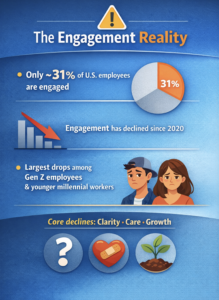
Recent workforce data shows employee engagement across the U.S. has declined from its post-pandemic high, with the steepest drops occurring among millennial workers and Gen Z employees. According to Gallup’s 2024 State of the Global Workplace report, only 31% of U.S. employees were engaged at work in 2024, representing a significant decline from 36% in 2020. For small and mid-sized businesses navigating today’s SMB talent challenges, this trend carries real consequences — but also real opportunity.
At Lloyd Staffing, we work closely with employers who don’t just want to hire talent — they want to keep it, develop it, and motivate it. Understanding why employee engagement is slipping — and what can realistically be done to restore it — is where meaningful retention strategies begin.
The Engagement Decline Employers Can’t Ignore
The numbers tell a sobering story. Employee engagement in the United States peaked during 2020 and has steadily declined since. According to Gallup’s workplace research, by 2024, only 31% of U.S. employees were considered engaged at work, down from 36% in 2020 — representing millions fewer engaged workers compared to just a few years earlier.
What’s most concerning for SMB employers is who is disengaging. Gen Z employees and younger millennial workers experienced the sharpest engagement declines, while older workers showed far more stability in engagement levels. Core engagement drivers — clarity, care, and growth — weakened year over year.
This data confirms what many business owners already feel operationally: employees are showing up, but not fully showing up.
Why Engagement Matters More Than Ever in Today’s Workforce
Employee engagement isn’t about perks, ping-pong tables, or motivational slogans. It’s about whether employees feel connected enough to give discretionary effort — the effort that fuels performance, loyalty, and innovation.
Engagement Directly Impacts Business Outcomes
Research consistently shows that engaged employees deliver higher productivity, stay longer to reduce turnover costs, provide better customer experiences, and contribute more consistently to team success. According to Gallup’s research on the cost of low employee engagement, low employee engagement costs the global economy approximately $8.9 trillion annually, or 9% of global GDP — driven by lost productivity, absenteeism, and attrition.
For SMBs — where every role matters and every departure hurts — employee engagement is often the difference between growth and stagnation.
Why Millennial Workers and Gen Z Employees Are Disengaging
Understanding the employee engagement decline requires understanding how the workforce has changed.
- Connection Has Weakened
Younger workers are less likely to feel someone at work genuinely cares about them as individuals. That sense of belonging — a critical engagement driver — has eroded, particularly in remote and hybrid work environments.
- Growth Feels Unclear
Millennial workers and Gen Z employees place high value on learning, skill development, and future opportunity. When growth paths feel vague or unavailable, employee engagement fades quickly.
- Expectations Aren’t Clear
Fewer employees today strongly agree they know what is expected of them at work. Ambiguity creates frustration — not flexibility.
- Managers Are Overextended
Many frontline managers were promoted for technical skill, not people leadership. Without training or support, employee engagement suffers at the team level.
These issues aren’t generational flaws — they’re organizational gaps that SMB employers can address strategically.

8 PRACTICAL WAYS SMBs CAN
IMPROVE EMPLOYEE ENGAGEMENT
Improving employee engagement doesn’t require enterprise budgets or sweeping cultural overhauls. It requires consistency, clarity, and leadership commitment. Here are eight proven strategies SMB employers can implement now.
- Clarify Roles and Expectations
Employee engagement begins with understanding. Employees who clearly understand their role and success metrics are significantly more engaged than those who don’t.
What SMBs can do:
Update job descriptions with outcome-based expectations, define what great performance actually looks like, and revisit goals quarterly rather than annually.
- Strengthen Frontline Managers
Managers influence employee engagement more than any other factor. Train managers in coaching, communication, and feedback. Encourage regular one-on-one check-ins and measure managers on team engagement, not just output.
- Create Visible Growth Paths
Growth doesn’t always mean promotion — but employees need to see forward momentum. Implement skill-based development plans, internal mentorship programs, and cross-training opportunities. This is especially critical for millennial workers and Gen Z employees, who disengage quickly when growth feels stagnant.
Industry Example: Technology SMBs
A mid-sized software development company faced high turnover among junior developers. By implementing quarterly ‘skill showcases’ where developers presented new technologies they’d learned and creating mentorship pairings with senior engineers, they increased employee engagement scores by 28% within six months and reduced early-stage turnover by 35%.
- Recognize Effort — Frequently and Authentically
Recognition doesn’t need to be expensive — but it must be genuine. Implement peer-to-peer recognition programs, publicly acknowledge wins, and provide timely, specific praise from leadership.
- Reinforce Purpose and Impact
Employees want to know their work matters. Connect daily tasks to company outcomes, share customer success stories, and involve employees in problem-solving discussions. Purpose fuels employee engagement — especially during periods of change.
- Support Work-Life Balance With Real Flexibility
Flexibility remains one of the strongest engagement drivers in today’s workforce. Offer hybrid schedules where possible, flexible start and end times, and respect personal boundaries outside work hours.
- Act on Feedback — Don’t Just Collect It
Survey fatigue is real. Employee engagement improves only when feedback leads to visible action. Share survey results transparently, prioritize two to three improvement areas, and communicate progress regularly.
- Prioritize Well-Being and Psychological Safety
Employees perform better when they feel safe, supported, and heard. Provide manager training on mental health awareness, establish open-door leadership policies, and encourage honest dialogue without fear.
Why Lloyd Staffing Emphasizes Engagement in Talent Strategy 
At Lloyd Staffing, we view employee engagement as inseparable from talent acquisition and retention. Hiring the right candidate is only the first step. Ensuring that individual feels supported, challenged, and aligned with your organization is what transforms a hire into a long-term contributor.
We partner with SMB employers not only to fill roles, but to align hiring with culture and leadership style, reduce early-stage turnover, and strengthen workforce stability through smarter recruitment strategy. Our approach recognizes that addressing SMB talent challenges requires more than filling open positions — it requires understanding what makes employees want to stay.
In a competitive labor market, employee engagement is no longer optional — it’s strategic.
The Bottom Line
Employee engagement is not declining because employees care less — it’s declining because workplaces haven’t kept pace with evolving expectations. For SMB employers facing ongoing talent shortages, the path forward isn’t simply hiring more people. It’s building environments where people want to stay.
When expectations are clear, growth is visible, managers are equipped, and employees feel valued, employee engagement follows — and so does performance. Organizations that invest in engagement today are the ones that will weather tomorrow’s workforce challenges most successfully.
************************************
Are you in need of hiring support with a staffing partner that you trust?
Let us help you find the right person for your role. Hire Now.
Are you working, but unsatisfied and ready for a new role?
Visit our Job Board to apply for one of our employment opportunities.
Related Reading
https://www.lloydstaffing.com/boost-low-employee-morale/
https://www.lloydstaffing.com/understanding-job-hugging/
************************************
ABOUT THE AUTHOR

Nancy Schuman, CSP is the former Chief Commuications Officer for LLoyd Staffing.
A recruitment and career specialist, Nancy has more than 40 years in the staffing industry – 27 of them with Lloyd. Now semi-retired, she remains an advocate for career education; she has advised thousands of candidates on their resumes and job searches while also serving as the Careers columnist for a large weekly Long Island newspaper. Nancy has written 11 popular books for job seekers and business professionals. You can find her Author’s page and books on Amazon. She continues to blog for Lloyd and coach job seekers at all levels, offering advice for today’s competitive workplace.