

PART 1 – STRATEGIC OFFBOARDING
By Jason Banks, President, CPS of Lloyd Staffing

FROM MY LINKEDIN FEED…
“A year ago, I posted on a LinkedIn a conversation I had with a candidate who accepted a position at a key company, resigning from her current employer, and the terrible negative experience that she experienced in those two (2) weeks between resignation and her new job.
The post received some excellent comments and interest so I wanted to revisit it because we experienced a very similar situation with a client, and again, a candidate had a similar, but even worse experience.
When will COMPANIES learn and adapt to an employee’s decision to leave? Why does it matter?
Despite her mixed emotions about leaving because of her loyalty and the relationships created during her tenure, the leadership at her company made her feel UNCOMFORTABLE, INCREASED HER STRESS, and IMPOSED DEADLINES for her TRANSITION that were UNREASONABLE.
She confided in me that her once positive outlook towards the company, its people, and leaders was OVER! No longer would she REFER them friends, potential talent, or customers.
The importance of PROFESSIONAL OFFBOARDING and how employees are transitioned out is just as pivotal as their initial onboarding process.
We live in a time when alumni hiring and referrals are an important strategy. A Morning Brew report shows that 55% of new hires are currently returning employees, up from 31% just a year ago. By their actions, this woman’s previous employer ruined that opportunity and burned the bridge, costing them referrals, future boomerang potential, and positive word of mouth.”
That story still haunts me because I see it constantly. Business owners have no idea how much damage they’re doing when they handle resignations poorly and it’s why I am expanding on my post.
The Hidden Cost of Bad Goodbyes
Here’s what most leaders miss: when you make someone’s final two weeks miserable, you’re not just losing one employee. You’re losing their entire professional network.
When you poison that relationship during the resignation process, you’re closing off your most valuable talent pipeline going forward.
Why People Actually Leave
The two candidates I mentioned weren’t disloyal. They gave notice. They tried to be professional. Their employers just couldn’t handle it gracefully.
Most people resign for predictable reasons that have nothing to do with hating their company. The top reasons are toxic work environments (32.4%), poor leadership (30.3%), and bad managers (27.7%). Pay actually ranks sixth at just 20.5%.
Sometimes people just need something you can’t offer right now—a promotion, geographic move, or industry experience. That doesn’t make them the enemy. If you handle it professionally, they’ll refer their best contacts to you. Handle it poorly, and they’ll actively warn people away.
The Real Financial Impact
Let me make this concrete. The first candidate from my post had relationships with three major clients who moved their business elsewhere after she left. She’d also planned to refer two perfect candidates—those referrals went to competitors instead.
The second candidate? She’s now in a position where she advises companies on vendor selection. Her former employer will never get that business. The financial damage in both cases? Easily six figures.
Companies save $3,000 per referral hire, and referral employees generate 25% more profit. When you burn bridges through bad offboarding, you’re throwing that away.
What Good Offboarding Looks Like

I’ve been privy to hundreds of resignation conversations over my career. The companies that do it right follow a simple pattern:
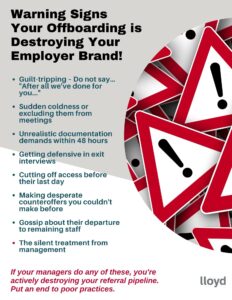
- Your first response sets everything. When someone hands in a resignation, say this: “Thank you for letting me know and for giving notice. I appreciate your contributions. Let’s talk about how to make this transition smooth for everyone.” That’s it. No guilt trips. No passive aggression. Just professionalism.
- Create realistic transition plans. Have an actual conversation about what matters most. Client handoffs? Critical documentation? What can wait? Don’t impose punishing schedules that make people regret giving notice.
- Treat them like humans during their notice period. They’re still part of the team. Include them in meetings. Conduct a genuine exit interview early in their notice period—not on their last day when everyone’s rushing. Ask open-ended questions and actually listen without getting defensive.
The companies that do this? Their departing employees refer friends, come back as clients, and sometimes return as boomerang hires with valuable new skills.
The companies that don’t? Those candidates actively warn their networks away and will never return.
Your Employees Are Watching
Here’s something that keeps me up at night: your current employees watch how you handle every resignation. They’re taking notes. 46% of professionals want to quit their jobs in 2025—higher than before the Great Resignation.
When you make departures miserable, your best people start job hunting without telling you. When you handle them professionally, they feel secure giving you notice because they trust they’ll be treated fairly.
In Part 2, I’ll share the boomerang reality reshaping hiring, practical SMB best practices you can implement tomorrow, and how to build an alumni network that becomes your most powerful talent pipeline.
Connect with me on LinkedIn to continue this conversation.
*********
Are you in need of recruitment support to help solve your organization’s hiring challenges? Trust our process.
Let us help you find the right person for your role. Hire Now.
Are you working, but unsatisfied and ready for a new role?
Visit our Job Board to apply for one of our employment opportunities. Have a conversation with one of our recruiters.
ABOUT THE AUTHOR

Jason Banks, CSP, is President of Lloyd Staffing. He leads the direct hire, executive search and contract talent communities of Lloyd. As a member of the executive leadership team, he continues to handle critical high level searches in verticals such as IT, Healthcare, Finance and more. He welcomes discussing how you can conquer hiring challenges by pivoting your hiring processes to leverage exceptional talent and maintain a consistent, high performing workforce with a powerful employment brand.
Related Reading…
https://www.lloydstaffing.com/category/resignation/
https://www.lloydstaffing.com/ending-your-employment-how-to-say-so-long-like-a-professional/
https://www.lloydstaffing.com/employee-retention-strategies/
https://www.lloydstaffing.com/employer-branding-why-it-matters/