It’s Now Bigger Than Fake Job Listings…
Recruitment scams are at a five-year peak, with deepfake video interviews, synthetic candidates, and AI-powered recruiter impersonation targeting candidates, employers, and staffing agencies alike. Here is what you need to know to stay ahead.
The digital handshake has officially entered a more dangerous era. In 2026, the primary threat in the labor market is no longer just a “fake job listing” — it is the sophisticated application of generative AI designed to deceive even the most experienced HR professionals and motivated candidates.
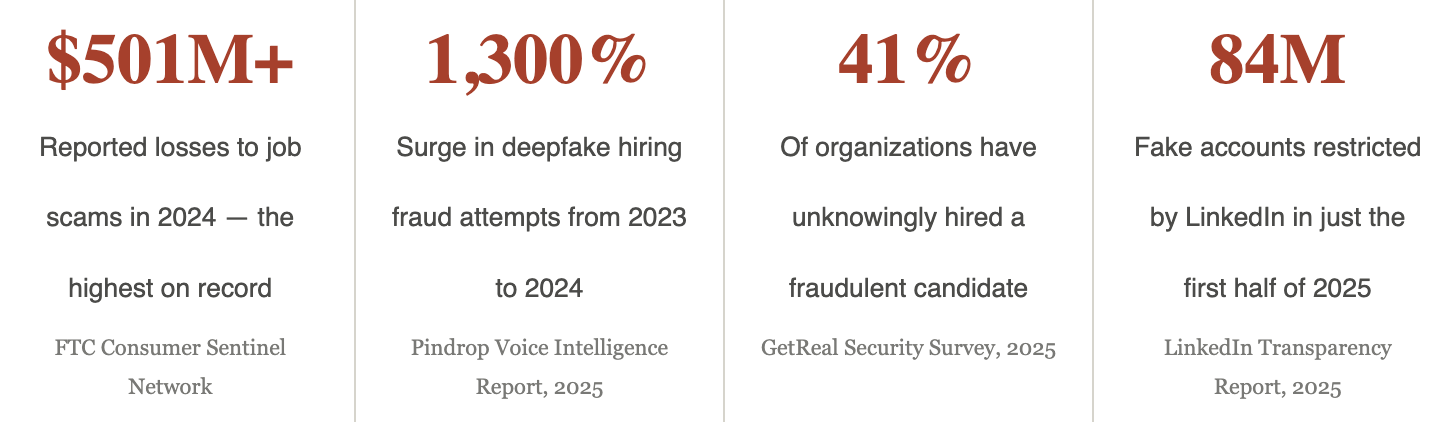
Reported losses from job search fraud jumped from $90 million in 2020 to over $501 million in 2024 — a 457 percent increase in four years, according to the FTC Consumer Sentinel Network. The FTC also estimates that fewer than 10 percent of fraud victims ever report to a federal agency, meaning the real toll is likely several times higher. As the 2026 job market deals with sustained layoffs — U.S. employers cut more than 1.17 million jobs in 2025, the highest since the pandemic — scammers are filling the gap with highly personalized, automated recruitment scams targeting all three sides of the hiring equation: candidates, employers, and recruiters themselves.
The 2026 Threat Landscape
Two years ago, a recruitment scam was betrayed by poor grammar and generic copy. Today, AI job scams deploy large language models (LLMs) to scrape a candidate’s LinkedIn profile and generate outreach that mirrors their exact professional history, tone, and career trajectory. Between May and July 2025 alone, job scams grew more than 1,000 percent, according to a McAfee report. The arms race is accelerating rapidly.
1. Scams Targeting Candidates: Identity Takeover
Hiring Scams
Candidates remain the primary target for financial extraction. The “equipment check” scam of prior years has evolved into a full-scale identity takeover operation backed by AI automation. The three dominant methods in 2026 are:
Virtual Desktop / RAT Malware: Candidates are “hired” and directed to download a proprietary “work-from-home security suite.” The software is a remote-access Trojan (RAT) that hands scammers full control over banking credentials and personal files.
Deepfake Video Interviews: Fraudsters use real-time face-swap filters to impersonate company executives during Zoom or Teams calls. Security firm Pindrop demonstrated this live on CBS News in 2025, transforming a reporter’s face in real time during a live call. Deepfake fraud attempts in hiring jumped 1,300 percent from 2023 to 2024.
Fake Career Portals: Mirror sites built to look exactly like a company’s real Greenhouse, Ashby, or Lever hiring page. They harvest resumes, passwords, and addresses, which are then tested against other accounts in credential-stuffing attacks.
2. Scams Targeting Employers: The Synthetic Candidate Crisis
Employers face a crisis of authenticity. According to research from background-screening firmCheckr, 23 percent of companies have already reported identity fraud among new hires. Gartner projects that by 2028, one in four candidate profiles worldwide will be fake — a trajectory already visible in 2026 hiring data.
The Multi-Hired Ghost Worker: Scammers use deepfake audio and video to pass interviews for multiple remote roles simultaneously, then use AI agents to automate work output — collecting multiple full-time salaries while providing minimal actual value. Amazon’s CSO disclosed in late 2025 that the company had blocked over 1,800 suspected North Korean (DPRK) applicants since April 2024, with attempts growing 27 percent quarter-over-quarter.
AI-Augmented Resume Fraud: LLMs generate hyper-credible resumes tailored to any job description. A 2025 Greenhouse survey of 4,136 hiring managers found that 91 percent had encountered or suspected AI-generated interview answers. Meanwhile, 31 percent of managers have personally interviewed a candidate using a fake identity.
These employer-side AI job scams are not theoretical. In June 2025, the DOJ announced a nationwide crackdown on a North Korean IT worker fraud network that used stolen identities of more than 80 U.S. citizens to secure jobs at over 100 American companies, causing more than $3 million in confirmed damages and prompting FBI searches of 29 suspected “laptop farms” across 16 states.
3. Scams Targeting Recruiters: The CRM Breach
Recruiters — both in-house and agency-based — are now being targeted as entry points for larger corporate hacks. Recruiter impersonation is among the most reputationally damaging threats in the industry, and one that directly undermines the trust between agencies and their clients.
Recruiter Impersonation: Fraudsters clone a recruiter’s full digital footprint — LinkedIn profile, email signature, agency branding — and use it to solicit placement fees from candidates, damage client relationships, and extract proprietary information about talent pipelines.
The Phishing Candidate: A seemingly ideal applicant sends a portfolio link or skills-assessment document. Clicking it triggers a credential-harvesting script targeting the recruiter’s access to the company’s Applicant Tracking System (ATS) or HR platform. These hiring scams drove a sharp rise in CRM breach incidents across recruitment firms in 2025.
Vijay Balasubramaniyan, CEO, Pindrop (People Management, January 2026)
“The sophistication of AI-generated fraud is accelerating at a pace that outstrips many current screening protocols.
Employers must now contend with candidates who can convincingly simulate identities, credentials, and even live interactions.”
The 2026 Employer Mindset: The Return to Human Vetting
In direct response to AI job scams and synthetic candidate fraud, 2026 has seen what talent-acquisition professionals are calling a “flight to quality.” Companies are stepping back from purely automated hiring pipelines and returning to human-led vetting — a shift with significant implications for the value of specialist recruitment partners.
By mid-2025, corporate giants including Google and McKinsey had reintroduced mandatory in-person interviews specifically to counter the surge in AI interview fraud, as reported by the Wall Street Journal. A new category of enterprise software — real-time deepfake detection from vendors including Pindrop, Reality Defender, and Sherlock AI — is rapidly becoming standard within video hiring platforms. However, only 19 percent of managers say they are “extremely confident” their current hiring process can detect identity fraud. For most organizations, a structured human vetting partner still provides a critical layer of protection before a fraudulent candidate reaches a final interview.
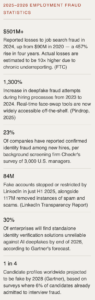
Employment fraud statistics
How to Stay Safe in 2026
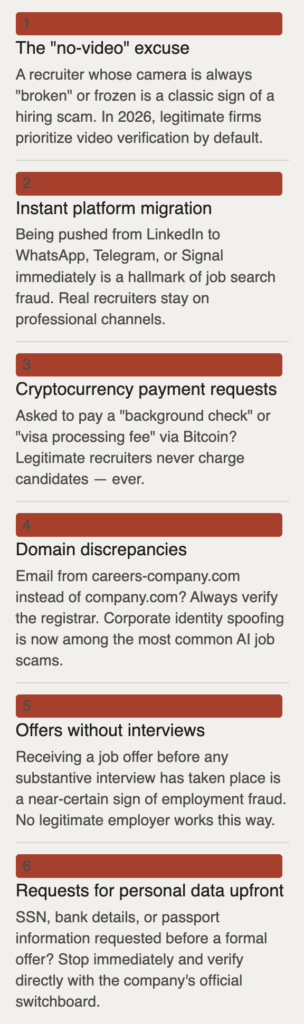
Multi-factor verification for every recruiter contact. If contacted by a recruiter, independently confirm their identity by contacting the company via its official website or main switchboard — not any contact details provided in the outreach itself.
Use live challenge tests during video interviews. Ask candidates to place a hand over their face, turn their head to profile view, or respond to an unscripted rapid-fire question. These three tests still reliably break current real-time deepfake software.
Use sandbox environments for all technical tests. For portfolio reviews, coding challenges, or document downloads, require secure, isolated browser environments to prevent credential-harvesting malware from executing.
Monitor your brand continuously across job platforms. Set AI-powered alerts to detect recruiter impersonation and ghost job listings bearing your company name on third-party boards, social media, and the dark web.
Move identity verification earlier in the funnel. Experts increasingly recommend verifying candidate identity at the application stage rather than the interview. Cross-checking profiles and sourcing from verified talent networks stops fraud before it reaches your team.
Report immediately when you encounter job search fraud. Report suspicious recruiter profiles to LinkedIn directly. File an employment fraud complaint at ReportFraud.ftc.gov. If financial information has been shared, contact your financial institution without delay.
Vigilance in the Age of AI
The 2026 job market offers genuine opportunity — but only for those who maintain high levels of digital hygiene. The defining shift of this era is that employment fraud statistics no longer reflect isolated criminal opportunism. They reflect a scaled, AI-automated industry targeting candidates, employers, and recruiters with equal sophistication.
The answer is not paralysis, but calibrated trust. By applying multi-factor human verification, staying current on evolving recruitment scam tactics, and partnering with established agencies that layer human judgment over automated screening, it is possible to navigate even the most fraud-saturated hiring environment with confidence.
For over 55 years, Lloyd Staffing has built its reputation on exactly that kind of trust. In an era where AI can fabricate a candidate’s face, voice, and work history, our commitment to rigorous human vetting, ethical practice, and direct accountability to both clients and candidates is not a differentiator — it is a necessity. When the integrity of the hiring process matters, experience and ethics are your best defense.
Whether you are a candidate protecting your identity, an employer protecting your organization, or a recruiter protecting your professional reputation, one principle now defines safe hiring in 2026: trust, but always verify — and make sure you know who you are trusting.
*************************
Are you an employer struggling to weed through fake resumes and other talent acquisition scams?
Let Lloyd’s certified professionals help you recruit and build a qualified authentic, Talent pipeline for your workforce.
Complete our Request Talent query to launch your search and we will have one of our Lloyd recruitment professionals reach out to you.
Are you a job candidate wondering if a job is real or not?
Let Lloyd help you find a real role with an organization that will value your skills and talent.
Visit Lloyd’s Job Board to apply for one of our current searches.
**************************
Written by Nancy Schuman, CSP, the former Chief Commuications Officer for LLoyd Staffing. A recruitment and career specialist, Nancy has more than 40 years in the staffing industry – three decades with Lloyd. Now semi-retired, she remains an advocate for career education and has advised thousands of candidates on their resumes and job searches. A former Careers columnist for a large weekly Long Island newspaper, Nancy has written 11 popular books for job seekers and business professionals. You can find her Author’s page and books on Amazon. She continues to blog for Lloyd and coach job seekers at all levels, offering advice for today’s competitive workplace.