

Healing Generational Workforce Imbalance:
Fixing the Talent Pipeline’s Quiet Crisis
Between scrambling to keep up with constant AI updates, managing the friction of multi-generational communication styles, and trying to keep remote teams genuinely engaged, modern leaders have plenty to keep them up at night. But while everyone is hyper-focused on the daily digital scramble and loud cultural debates, a much bigger, quieter crisis is creeping into corporate America’s workforce.
This problem has nothing to do with software updates or office red tape. It’s a matter of simple human geography: the talent pipeline is facing a major structural disconnect.
A recent Fortune article put the spotlight right on this demographic shift. As Svenja Gudell, chief economist at Indeed, pointed out, “generational imbalance is straining the workforce.” The math is clear. The population is shifting rapidly, and there simply aren’t enough young workers entering the market to backfill critical senior roles as veteran professionals step away.
At Lloyd Staffing, we see this strain hitting businesses every single day. When an experienced professional leaves, they don’t just leave an empty desk. They take decades of institutional knowledge, unwritten processes, and deep client relationships with them.
The talent shortage is real, but it doesn’t have to break your business. Here is how forward-thinking companies can heal the generational workforce imbalance, bridge the talent gap, and turn a tricky demographic shift into a major competitive advantage.
 Stop the “Brain Drain” with Two-Way Mentorship
The single biggest risk of a generational imbalance is losing what we call “tribal knowledge”—the critical business info that lives entirely in your senior employees’ heads and is never written down anywhere. Demographic data highlights the urgency: nearly 4.1 million Americans are hitting retirement age annually, an unprecedented wave of departures often called the “Peak 65” boom.
To heal this gap, you have to make knowledge transfer a natural part of your work culture, not something you scramble to do during an employee’s two-week notice.
- Establish collaborative project pairing: Move past casual, unstructured check-ins. Assign a veteran professional and a rising star to co-lead high-priority initiatives. This structure allows the senior employee to steer the high-level strategy and client nuances while the junior employee handles the execution, capturing critical workflows in real time.
- Create deliberate mentorship recognition: To make collaboration stick, it must be celebrated. Publicly recognize and reward pairs who successfully reach milestones together. This reinforces the value of knowledge sharing and elevates the status of mentors within the firm.
- Embrace reverse mentorship: Knowledge transfer goes both ways. Your younger workers are digital natives who can easily help upskill veteran employees on modern software, automation tools, or generative AI. This builds mutual respect and keeps your entire team sharp.
- Document the unwritten rules: Have your transitioning pros record short, simple video walkthroughs of complex proprietary systems or write basic playbooks for managing key client relationships.
 Build a Smooth Off-Ramp with Phased Retirement
Retirement used to be an all-or-nothing milestone. You hit a certain age, had a party, got a gold watch, and vanished. But today, many veteran workers don’t actually want to stop working cold turkey. They just want a little more balance, less administrative stress, and better flexibility.
Smart companies are building comfortable, strategic off-ramps instead of throwing people out the door. Studies track this shift closely, showing that a rising percentage of older professionals plan to work past age 65 because they genuinely enjoy their careers and want to stay mentally active.
By creating a phased retirement program, you allow valued senior team members to transition smoothly from full-time grind to part-time or advisory roles. Options like reduced work weeks (such as three-day schedules) or tailored hybrid arrangements keep their incredible expertise inside your building for an extra year or two. This gives you a massive runway to train their successor and keeps your project timelines moving without a hitch.
 Pivot Fast with Fractional Leadership
What happens if a senior leader steps down and you absolutely cannot find a qualified, full-time replacement in a tight job market? You don’t have to panic, and you don’t have to settle for an under-qualified hire. You look to fractional talent.
 As a comprehensive workforce solutions partner, Lloyd Staffing regularly provides fractional leadership to organizations facing these exact talent pinches. Furthermore, Lloyd has a proven track record of successfully integrating contract workers into client environments, ensuring that temporary or part-time professional support hits the ground running without disrupting your workplace culture.
Hiring fractional executives or project-based consultants allows you to inject elite, decades-deep expertise into your business exactly when and where you need it. Whether you need a part-time CFO to guide a transition or a veteran Operations Lead to steady a department, fractional leadership recruitment solves your immediate talent gaps. It gives you top-tier capability without the long-term overhead of a massive full-time salary and benefits package.
 Modernize the Work Environment and Investment in Upskilling
If you want to keep your best people from exiting the workforce early, you need to look at what actually drives them away. Hint: It’s rarely the work itself. It’s usually a lack of flexibility or a rigid corporate environment.
- Lean into real flexibility: Remote and hybrid work options aren’t just for 20-somethings who want to work from a Starbucks. They are an absolute game-changer for veteran workers who are tired of grueling daily commutes or who need to balance their jobs with personal health and family care.
- Sponsor company-provided online courses: There is a lazy stereotype that veteran workers don’t want to learn new technology. In reality, they are incredibly adaptable—they just need accessible, practical training. Companies can heal the pipeline gap by funding continuing education through platforms like Udemy or other specialized online courses. When you actively invest in upskilling your existing roster courtesy of the company, you instantly reduce your need to hunt for external talent.
 Revitalize Workplace Engagement and Culture
Healing the generational workforce imbalance requires an active investment in your company’s community. Gallup analytics consistently demonstrate that highly engaged teams experience significantly lower turnover, a factor that is more critical than ever when trying to stabilize a shrinking talent pipeline. A fractured, disconnected culture only accelerates retirement timelines and drives up turnover among younger staff.
- Mix remote and real-world connection: Keep teams tight with interactive virtual events like digital trivia happy hours that bridge geographical gaps and break down social walls.
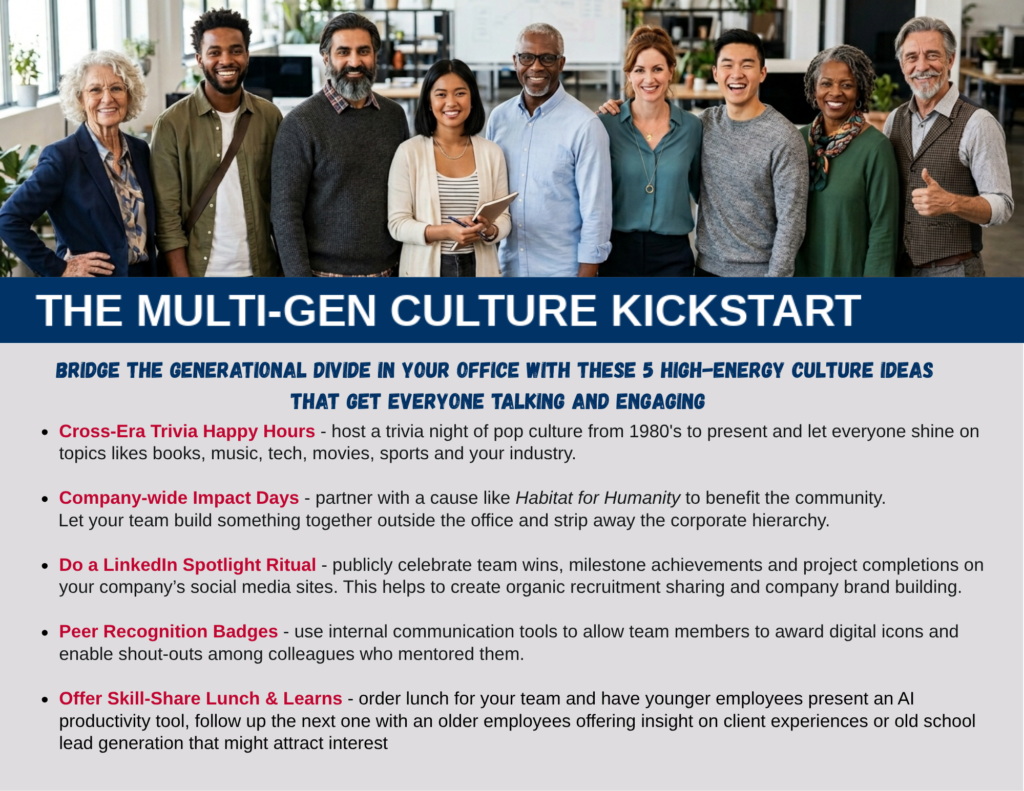
Workforce Engagement - Rally around a shared purpose: Organize corporate or community projects, connect with an organization like Habitat for Humanity to see if there is project taking place in your region where your employees can participate. Giving your multi-generational workforce a tangible, hands-on cause to support outside the office builds deep organizational bonds that text channels simply cannot replicate.
- Leverage culture for recruitment and social sharing: These cultural touchstones do double duty. When employees share photos and stories from a Habitat for Humanity build or a team trivia victory on LinkedIn, it acts as a massive employer-branding magnet. It shows potential candidates of all generations that your company values real connection, making your talent pipelines significantly easier to fill.
 Put Onboarding on a Fast Track
Because the pool of incoming younger workers is smaller, you can’t afford to waste time when you do make a great new hire. The days of letting an entry-level employee spend six months “learning the ropes” through osmosis are officially over.
You need an onboarding process that gets people up to speed fast. Break training down into bite-sized, interactive modules. Give them clear, immediate feedback, and map out exactly what success looks like in their first 30, 60, and 90 days. The faster a new hire feels confident and competent, the less strain your remaining team feels.
Bottom Line: Sync the Scales or Get Left Behind
The shifting population isn’t a temporary trend that will disappear next quarter. It is a permanent realignment in how corporate America functions. Companies that choose to ignore this generational imbalance will find themselves trapped in expensive, exhausting bidding wars for dwindling talent, all while watching their institutional memory walk out the front door.
But if you face the issue head-on by modernizing your knowledge transfer, offering flexible career paths, utilizing fractional talent, and adapting your workplace culture, you won’t just survive the strain—you will build a faster, smarter, and incredibly resilient multigenerational workforce.
The demographic shift is already here. Is your company ready to lead the way?
Need help bulletproofing your talent pipeline or finding the perfect fractional leader? Connect with the workforce experts at Lloyd Staffing today and let’s build a custom hiring strategy for your business.
Need more info? Read these relevant blogs from Lloyd:
How Fractional Recruiting Can Boost Your Company’s Growth
How to Bridge the Generation Gap and Manage Gen Z Employees
************************************

ABOUT THE AUTHOR
Nancy Schuman, CSP is the former Chief Communications Officer for Lloyd Staffing.
A recruitment and career specialist, Nancy has more than 40 years in the staffing industry – 27 of them with Lloyd. Now semi-retired, she remains an advocate for career education; she has advised thousands of candidates on their resumes and job searches while also serving as the Careers columnist for a large weekly Long Island newspaper. Nancy has written 11 popular books for job seekers and business professionals. You can find her Author’s page and books on Amazon. She continues to blog for Lloyd and coach job seekers at all levels, offering advice for today’s competitive workplace.
Special Note: I am grateful Lloyd Staffing has given me the opportunity to continue writing blogs on a contract basis. My former employer has put their own advice into practice!