

THE NEW CONTRACT WORKFORCE: AI, FLEXIBILITY AND WHAT’S AHEAD
Picture the conversation at any office happy hour lately: “Is my job going to a robot, a contractor, or just… me, but faster?” It’s the question running quietly under a lot of workplace small talk right now.
Last week, Lloyd and the rest of the staffing industry marked National Staffing Employee Week, honoring the millions of contract and temporary professionals who keep organizations running. Lloyd has been part of this community since 1971, so we’ve watched this world change more than once. But the shift happening now, powered by AI and a genuinely reshaped idea of flexible work, might be the biggest one yet.
IT’S NOT YOUR GRANDMA’S TEMP JOB ANYMORE
There was a time when “temporary worker” conjured a pretty narrow image: someone filling a desk for a few weeks until the “real” hire showed up. That picture is almost quaint now. Today’s contract professional might be the technologist leading a system implementation, the healthcare specialist closing a critical staffing gap, the finance expert steering a company through a transition, the supply chain strategist untangling a bottleneck, or the creative brought in because nobody in-house has quite the branding savvy needed for the moment.

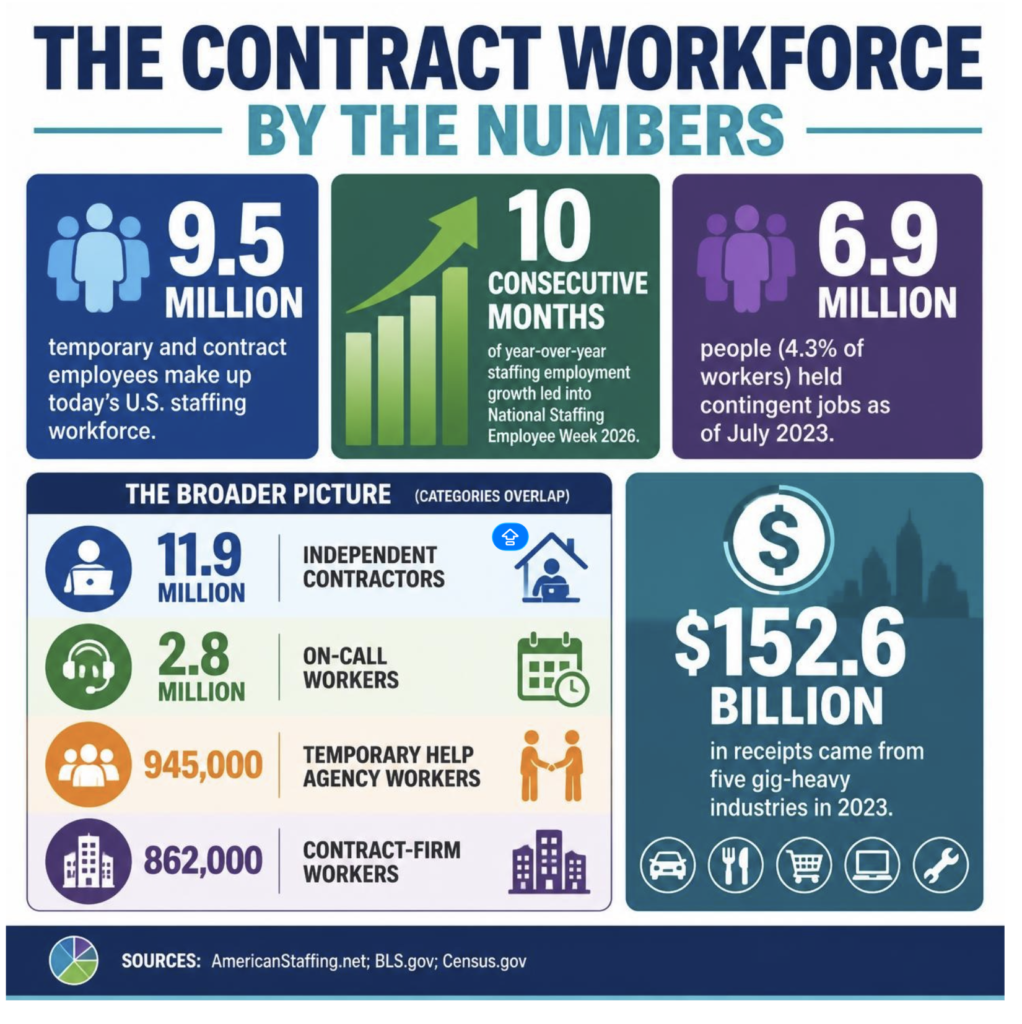
The numbers back up what anyone in this industry already senses. The American Staffing Association estimates 9.5 million temporary and contract employees are part of the U.S. workforce today, and National Staffing Employee Week 2026 landed on the heels of ten straight months of year-over-year growth in staffing employment. Contract work isn’t a placeholder anymore. It’s a deliberate strategy, one that gives companies access to sharp, specific skills exactly when they need them, while giving professionals a way to build experience, widen their network, and stay nimble in a job market that rewards nimbleness.
“GIG ECONOMY” DOESN’T QUITE COVER IT
We tend to lump all of this under “the gig economy,” as if driving for a rideshare app and consulting on a six-month ERP rollout are the same thing. They’re not. The U.S. Bureau of Labor Statistics found that 6.9 million people, or 4.3% of the workforce, held contingent jobs as of July 2023, alongside 11.9 million independent contractors, 2.8 million on-call workers, 945,000 temporary help agency employees, and 862,000 workers placed through contract firms. These categories overlap, so they don’t simply stack into one tidy total.
AI ISN’T A SEPARATE JOB MARKET. IT’S ALREADY IN THE ROOM
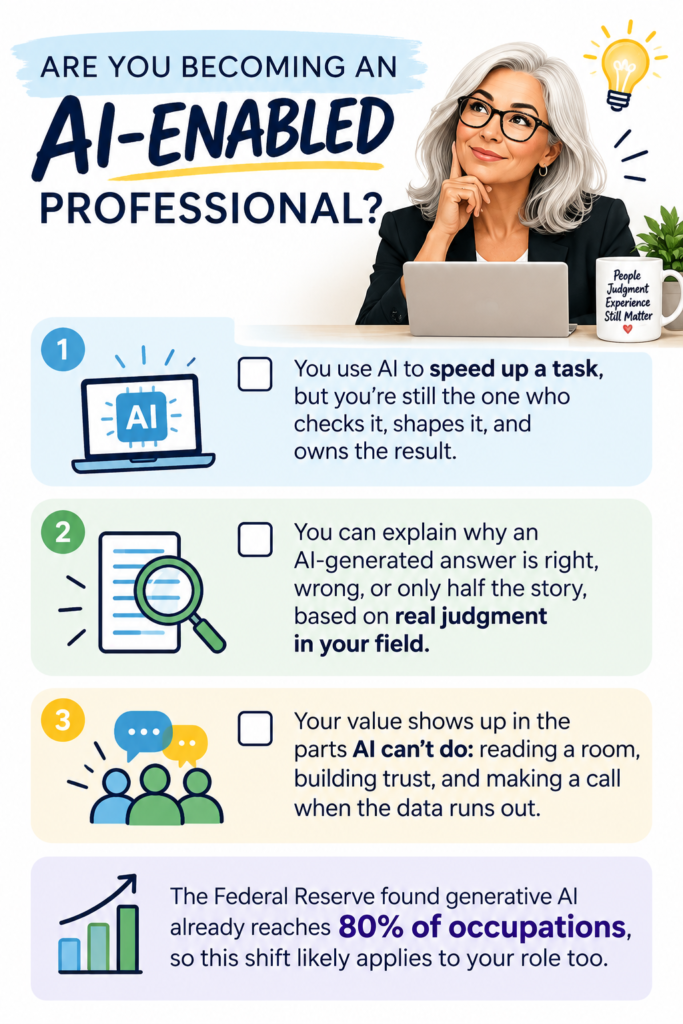
Here’s where things get interesting. AI isn’t showing up as its own category of work, off in a corner labeled “automation.” It’s quietly embedding itself into jobs that already exist. A 2026 Federal Reserve research study found that at least one in five workers now uses generative AI in 80% of occupations, touching roughly 40% of job tasks. Adoption is still under 50% in most of those occupations, but the reach is already remarkably broad.
That changes the question people should be asking, from “will AI touch my job?” to “how will it change the way I do my job?” A recruiter might lean on AI to sort information and surface matches. A financial analyst might use it to speed up modeling. A marketer might turn to it for research or a first draft. In every case, a person is still holding the context, the judgment, and the accountability for the final result. That’s created a new kind of talent worth watching for: the AI-enabled professional, someone who pairs technical fluency with real expertise in the work itself.
HUMAN SKILLS AREN’T GOING ANYWHERE
None of this makes traditional skills less valuable, it just clarifies which ones matter most. The latest BLS projections show total U.S. employment climbing from 170.3 million jobs in 2025 to 176.2 million by 2035, an increase of nearly 5.9 million jobs. And across virtually every occupation on that list, BLS points to the same trio rising to the top: adaptability, attention to detail, and interpersonal skills.
It’s not just the tech-forward roles growing quickly, either. Data scientist employment is projected to grow 34.6% over the decade, which tracks with everything we hear about AI. But nurse practitioner employment is projected to grow even faster, at 41.0%, a reminder that plenty of the fastest-growing work still depends entirely on human connection. The takeaway for employers and candidates alike: technical skill and human skill were never actually competing for the same slot. The workforce ahead needs both, in the same person, often at the same time, which is exactly the profile of the AI-enabled professional taking shape across so many industries right now.
WHAT IS 2027 LIKELY TO LOOK LIKE?
Picture a workforce that’s genuinely blended: full-time employees, contract professionals, consultants, project specialists, independent talent, and AI tools, all working the same problem from different angles. Not every company will use every model, but workforce planning itself is loosening up. A business might need a technology specialist for one implementation, extra healthcare talent during a demand spike, a finance expert to steer a transition, or a creative lead for a single big campaign. The need is real even when a permanent headcount line isn’t.
That’s the moment when the question shifts from “do we have an open req?” to “what capability do we actually need, how fast do we need it, and what’s the smartest way to get it?” For candidates, that same shift opens doors. Contract work offers exposure to new industries, systems, and teams, building a portfolio of real accomplishments faster than waiting patiently on a single ladder. The traditional career path isn’t disappearing, but for a lot of people, it’s becoming less linear and more skill-driven, chapter by chapter rather than rung by rung.
WHERE A REAL STAFFING PARTNER PROVES ITS’ VALUE
Technology is genuinely good at scanning resumes and organizing information. What it still can’t do is understand a client’s business the way a person who’s spent years inside that industry can, or read a candidate as more than a stack of keywords. That’s where the human side of staffing keeps its value, arguably more so as everything else speeds up.

Through six decades, Lloyd Staffing has connected organizations and professionals across Healthcare, Life Sciences, Technology, Finance, People Operations, Supply Chain, Sales, and Creative. Our contract workforce model gives clients flexible access to talent for short-term, long-term, and contract-to-hire needs, while giving professionals a path to opportunities that genuinely expand what they can do next. As the workforce gets more complex, a good staffing partner’s job shifts too, from simply filling a seat to helping both sides find the right fit.
LOOKING AHEAD
The future of work was never really “humans versus AI.” It’s people using better tools to do better work, and organizations getting smarter about how they bring the right people and capabilities together at the right moment. The contract workforce sits right at the center of that shift. The gig economy keeps evolving, AI keeps working its way into more tasks, and employers keep navigating a market where speed and specialized skill matter as much as anything on a resume.
- For candidates, that means staying curious and ready to show what you can actually do, not just what’s listed on a resume.
- For employers, it means thinking more broadly about how a workforce gets built and strengthened.
And for staffing partners like Lloyd, it means staying close to both sides of that equation, always. During National Staffing Employee Week, we were proud to recognize the millions of contract and temporary professionals whose flexibility and skill keep organizations moving. The workforce of 2027 is already taking shape, and building it well means bringing people, technology, and flexibility together on purpose. If you’re starting to think through your 2027 strategy, for contract talent or your next permanent hire, we’d welcome the conversation. Stop by our Melville, Long Island headquarters, or we’re happy to meet you on your site or over Zoom.
*********
Lloyd offers the following practice areas as resources for Contingent Talent.

If you are an employer ready to have a conversation about exploring a contingent workforce strategy, we welcome hearing from you. REQUEST TALENT
Related Reading
https://www.lloydstaffing.com/consultant-temporary-talent-as-a-staffing-strategy-for-smbs/
https://www.lloydstaffing.com/not-using-a-contingent-workforce-strategy/
 ABOUT THE AUTHOR