
When asked, What is the future of the resume, you might very well get this response…
“The résumé will be gone in two years or less.”
That prediction comes from Lloyd Staffing President Jason Banks. It is a bold statement, especially considering the résumé has survived for more than 500 years.
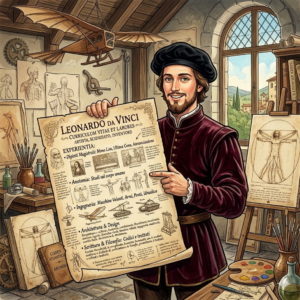
Historians often point to Leonardo da Vinci’s 1482 letter seeking employment
with the Duke of Milan as the world’s first résumé. More than five centuries later, job seekers are still using some version of the same concept: a document designed to communicate experience, skills, accomplishments, and value.
So is Jason right?
Will artificial intelligence finally accomplish what typewriters, fax machines, job boards, applicant tracking systems, and LinkedIn could not? Perhaps. But before we start planning the résumé’s funeral, it may be worth examining what is actually changing—and what isn’t.
-
AI Has Become Everyone’s Resume Writer
Not long ago, writing a strong résumé was a skill unto itself. Today, candidates can ask AI to create accomplishment statements, rewrite summaries, tailor content for specific positions, optimize keywords, and even build an entire AI resume in minutes.
For many job seekers, this is a positive development. Qualified candidates who struggle to write about themselves now have access to tools that help them present their experience more effectively.
But there is a downside. –– When everyone has access to the same technology, many applications begin to sound remarkably alike. Recruiters are seeing more polished résumés than ever before, yet distinguishing one candidate from another has become increasingly difficult. The result is a strange paradox: résumé quality is improving while differentiation is becoming harder.
-
Employers Are Beginning to Trust Resumes Less
Artificial intelligence has created a new question for employers:
“Am I evaluating the candidate—or the software?”
Research suggests many organizations are becoming increasingly skeptical about résumé accuracy as generative AI tools become more common. That skepticism doesn’t mean employers are abandoning résumés. It means they are relying on them differently.
A résumé used to be viewed as evidence. Today, it is increasingly viewed as a starting point for further investigation.The document still matters. Trusting it blindly matters less.
-
Skills-Based Hiring Is Replacing Assumptions
One of the most significant shifts in recruiting is the move toward skills-based hiring. Employers increasingly want to know what candidates can actually do—not simply where they worked or what degree they earned.
- Can they solve problems?
- Can they lead people?
- Can they communicate effectively?
- Can they perform the tasks required by the role?
Skills assessments, portfolios, certifications, work samples, and project demonstrations are helping employers answer those questions more effectively than a traditional résumé alone.
The future of the resume may be less about describing skills and more about supporting them with evidence.
-
LinkedIn Has Expanded the Resume
If there is one platform that has fundamentally changed recruiting, it is LinkedIn.
Many recruiters now review a LinkedIn profile before reviewing a résumé. Some candidates are contacted for opportunities without ever submitting one.
Yet LinkedIn has not replaced the résumé. It has expanded it. Unlike a traditional résumé, LinkedIn can include recommendations, certifications, articles, volunteer work, portfolios, professional achievements, and ongoing career activity.
- It provides context.
- It provides visibility.
- It provides credibility.
The résumé remains a concise summary tailored to a specific opportunity. LinkedIn provides the broader story of a professional career. Together, they create a more complete picture together than separately.
-
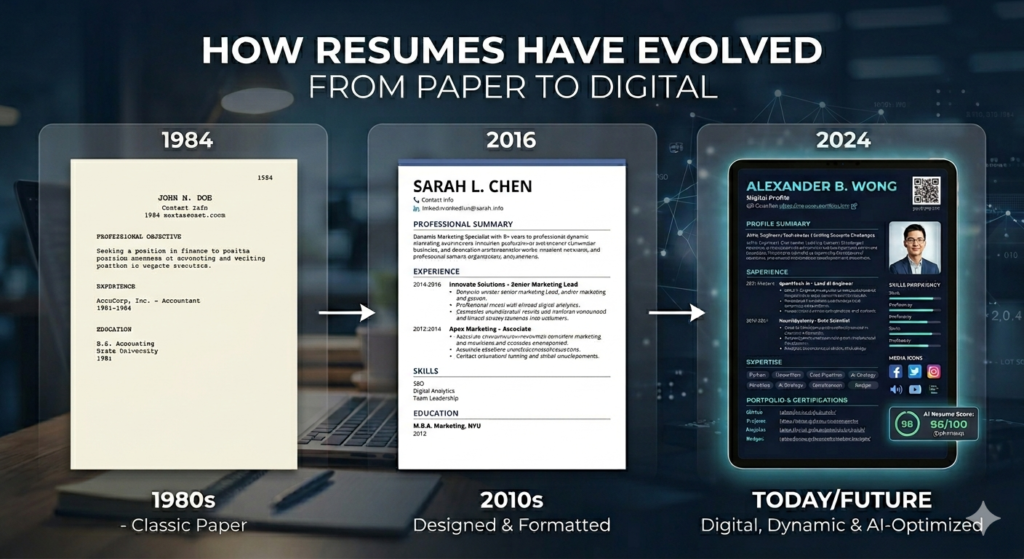
The Digital Talent Profile Is Emerging
Increasingly, employers are evaluating candidates through multiple sources rather than relying on a single document. Imagine a professional profile that combines:
- Employment history
- Certifications
- Skills assessments
- Portfolio samples
- References
- Accomplishments
- Professional development
- Online presence
In many ways, this already exists. The résumé is becoming one component of a larger professional identity. That evolution doesn’t diminish the value of the résumé. It simply changes its role.
-
Candidate Assessment Is Taking Center Stage
As confidence in résumé content becomes more complicated, candidate assessment is becoming more important.
Organizations are relying more heavily on:
- Skills testing
- Structured interviews
- Behavioral assessments
- Work simulations
- Certification verification
- Digital portfolio reviews
This trend benefits employers because it reduces hiring risk. It also benefits candidates because it creates more opportunities to demonstrate strengths that may not be fully reflected on paper. The hiring process is becoming less about what candidates claim and more about what they can prove.
-
Staffing Firms Are Becoming Truth Detectors
Perhaps the biggest winner in this changing landscape is the experienced recruiter. As AI makes it easier to create impressive applications, employers increasingly need help separating presentation from reality. This is where staffing firms create value.
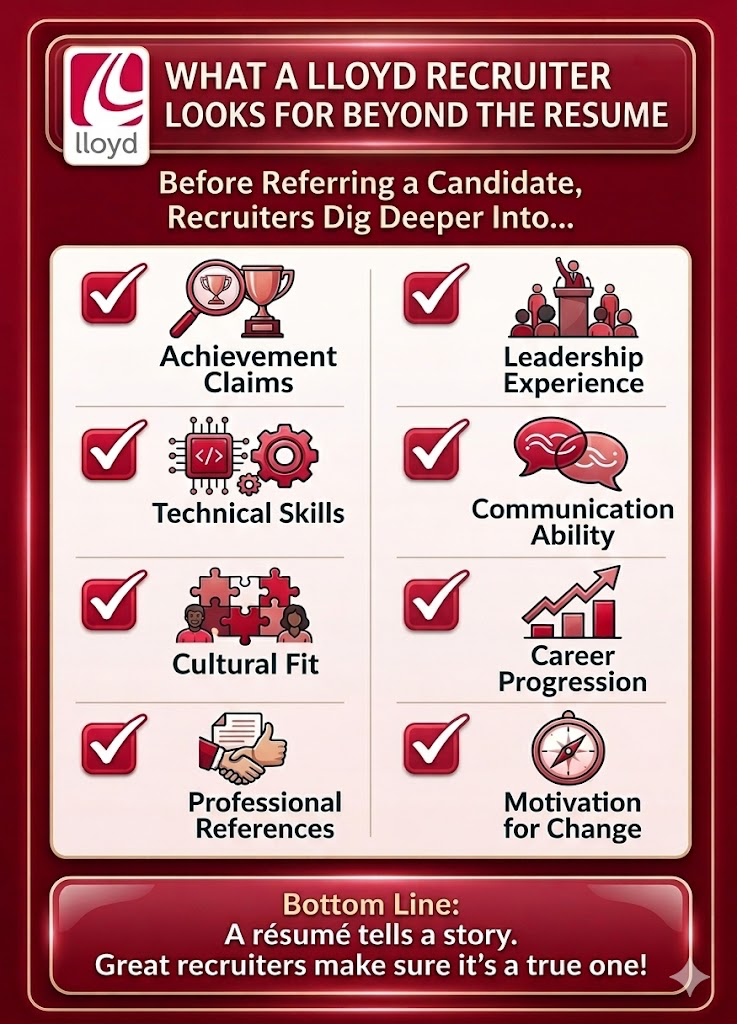
At Lloyd Staffing, a résumé is never accepted at face value. It is examined. Questioned. Verified. A candidate may claim they “led a major initiative.” An experienced recruiter wants details.
- What was the initiative?
- How many people were involved?
- What challenges were faced?
- What measurable results were achieved?
- What role did the candidate personally play?
A résumé may say “leadership.”
A recruiter determines whether that leadership involved five employees or fifty.
A résumé may suggest technical expertise.
A recruiter evaluates whether the candidate can confidently discuss and demonstrate that expertise.
A résumé may imply cultural fit.
A recruiter explores whether that fit truly exists.
In many ways, today’s recruiters have become talent detectives. As AI makes résumé writing easier, validating the information behind those résumés becomes even more important.
For client companies, that creates confidence. For candidates, it creates credibility. And for everyone involved, it leads to better hiring decisions.
So, Will the Resume Disappear?
Unlike my colleague Jason Banks, I’m not ready to write its obituary. As the author of eleven career guidance books and someone who has written tens of thousands of résumés over a career spanning more than forty years, I’ve watched this document evolve through every major shift in recruiting.
I’ve heard predictions of its demise before.
–The personal computer was supposed to change everything.
–Job boards were supposed to change everything.
–LinkedIn was supposed to change everything.
–Now AI is supposedly changing everything. And in many ways, it is.
But perhaps we’re asking the wrong question. Instead of asking whether the résumé will survive, we should ask whether it will evolve?
Consider the automobile. The cars we drive today bear little resemblance to those driven by our parents or grandparents. Their appearance has changed. Their engines have changed. Their technology, navigation systems, safety features, and performance capabilities would have seemed unimaginable a generation ago. Yet despite all those changes, their purpose remains exactly the same. They help people get where they want to go. I believe the résumé will follow a similar path.
The package will change. Paper will become digital. Bullet points may give way to portfolios, assessment scores, verified credentials, LinkedIn profiles, and AI-powered talent records. But candidates will still need a way to tell their story. Employers will still need a way to evaluate that story. And staffing firms like Lloyd Staffing will continue helping both sides determine whether the story is authentic.
The résumé of tomorrow may look dramatically different from the résumé of today.
But I suspect it will continue serving the same purpose it always has: helping talented people find opportunities and helping employers find talent.

Staffing industry leader, Jason Banks, however, believes the transformation will go even further.
“Whether we call them résumés or something else may become irrelevant,” says Banks.
“What employers will increasingly rely on are digital talent assets that are tailored to specific opportunities, supported by verified skills, validated experience, and authenticated identities. The document itself will matter less than the proof behind it.”
Banks believes that as AI continues to improve, verification will become one of the most important aspects of hiring.
“Today, technology can create impressive applications in seconds, but it cannot guarantee authenticity,” he explains. “That’s why I believe we’ll see a renewed emphasis on validation, recruiter vetting, and meaningful face-to-face conversations. In many ways, the interview may become more important than ever because employers need confidence they are hiring the person—not simply the profile.”
Whether the résumé ultimately evolves or eventually disappears, both perspectives arrive at the same destination. The future of hiring will be built on trust.
And in a world where technology can create almost anything, proving what is real may become the most valuable qualification of all.
Related Reading
Building Unshakeable Client Trust: How the Human Element Transforms Talent Acquisition for SMBs
************************************
Are you in need of hiring support with a staffing partner that you trust?
Let us help you find the right person for your role. Hire Now.
Are you working, but unsatisfied and ready for a new role?
Visit our Job Board to apply for one of our employment opportunities.
************************************
ABOUT THE AUTHOR

Nancy Schuman, CSP is the former Chief Commuications Officer for LLoyd Staffing.
A recruitment and career specialist, Nancy has more than 40 years in the staffing industry – 27 of them with Lloyd. Now semi-retired, she remains an advocate for career education; she has advised thousands of candidates on their resumes and job searches while also serving as the Careers columnist for a large weekly Long Island newspaper. Nancy has written 11 popular books for job seekers and business professionals. You can find her Author’s page and books on Amazon. She continues to blog for Lloyd and coach job seekers at all levels, offering advice for today’s competitive workplace.