
The Workforce in Transition: A 4-Part Series from Lloyd – Part 4

The question isn’t whether AI workforce strategy will change how you hire. It already has. Here’s how to stop being behind
By now you’ve sat through at least one presentation, read at least a dozen articles, and had at least a few conversations about what AI is going to do to your workforce. Maybe you came away with a plan. More likely you came away with a vague sense of urgency and no clear next step.
That’s not a failure of attention. It’s a failure of framing. Most AI-and-workforce conversations are pitched too broadly to be useful. “AI will transform how we work” is true the way “weather affects travel” is true — accurate, not actionable.What’s more useful is a ground-level look at what we at Lloyd actually happening in the talent market right now — who’s building AI skills, which roles are gaining value, and what a smart AI workforce strategy in 2026 looks like for an employer trying to compete for good people. The answers are more surprising than most of the coverage suggests.

Wrong assumption 1: AI is coming for contract workers first
When automation started making real noise in business circles, most employers filed it under a predictable narrative: the flexible, contingent workforce — contract workers, project hires, temps — would feel the impact earliest. The logic seemed sound. If AI automates repetitive, task-based work, and contract workers often fill repetitive, task-based roles, they’d be the most exposed.
The data landed differently.
According to the ASA/LinkedIn State of Staffing & Search Report, staffing-engaged professionals added AI literacy skills 40% faster than the overall LinkedIn member population in 2023. By 2025 that rate had climbed to 46% faster. More striking: in AI engineering — the harder, more technical end of the spectrum — contract workers went from 21% behind the broader workforce in 2023 to 7% ahead of it by 2025.
Two years. A complete reversal.
The reason isn’t complicated. Contract professionals operate without the cushion of a permanent salary and a stable org chart. Their next engagement depends on what they can offer right now. When the market started signaling that AI fluency mattered, they didn’t wait for a development plan. They went and built the skill. Permanent employees, on average, moved more slowly — not because they’re less capable, but because the immediate pressure was different.
For employers building an AI workforce strategy in 2026, this changes the horizon considerably. The contract talent pool isn’t behind on AI. In many cases, it’s the fastest available path to bringing genuine AI capability into your organization.
Wrong assumption 2: hiring AI-fluent talent is enough
Here’s where a lot of employers get tripped up. They recognize the need for AI-skilled professionals, they go out and hire them — and then not much really changes. The tools don’t get used. The workflows don’t shift. The capability sits in one person’s job description and doesn’t spread.
Bringing in AI-fluent talent only creates value if the organization is ready to use what those people bring. If your processes, your managers, and your culture aren’t set up to take advantage of that capability, the advantage evaporates quickly. You end up paying for a skill you can’t deploy.
Before the next search for AI-ready talent, the more honest question is: are we ready to receive it? Do our managers understand what AI-assisted work actually looks like? Are our workflows set up to integrate it? Is there someone senior enough to champion the change when it meets organizational resistance — because it will?
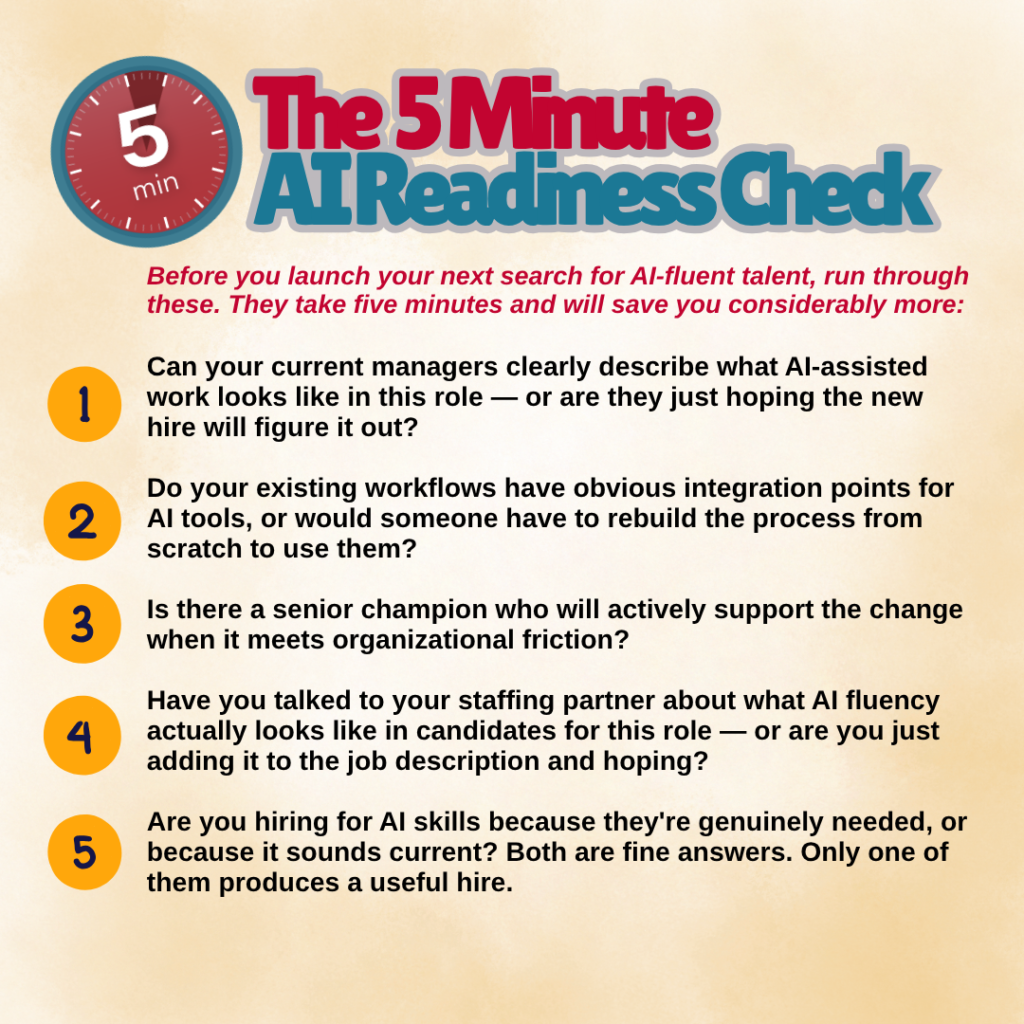
This isn’t an argument against hiring for AI fluency. It’s an argument for doing the internal work alongside the external search, rather than assuming the hire alone will close the gap.
Wrong assumption 3: AI changes which tools people use, not which people you need
The deeper shift in the talent market isn’t about software proficiency. It’s about which kinds of work are becoming more valuable — and which are quietly losing ground.
Roles built around repeatable processes are contracting across every industry. Not disappearing — contracting. Administrative functions that follow predictable patterns. Quality assurance roles organized around checklists. IT support that consists mostly of running the same diagnostics in a different sequence. Automation is absorbing this work with increasing efficiency, and the trend is not reversing.
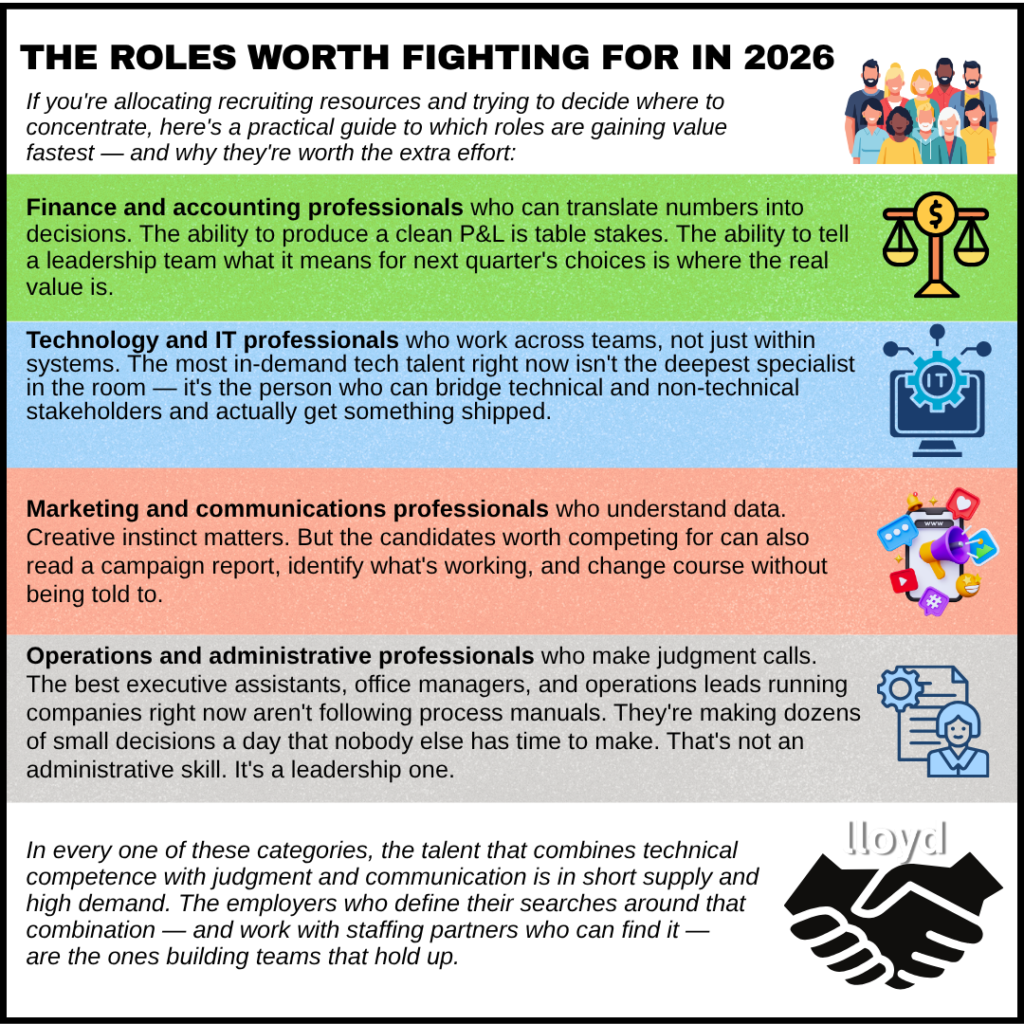
What’s gaining ground — and commanding better compensation, shorter time-to-fill, and more employer competition — are roles that require genuine judgment. The project manager who can hold a room of competing stakeholders together and still ship something. The analyst who knows which questions to ask before running the numbers. The business development professional who builds relationships that don’t exist yet and can’t be scripted. The operations lead who sees around corners that aren’t on anyone’s dashboard.
The ASA/LinkedIn State of Staffing & Search Report found that six of the ten industries making up 80% of temporary employment saw ten or more entirely new skills emerge in their top-15 most in-demand lists in 2025 alone. The job you’re hiring for today almost certainly requires a different profile than the same job title did three years ago.
If your hiring is still organized around titles and task lists rather than outcomes and judgment, you’re describing a role that’s becoming less relevant — while the candidates who could genuinely move your organization forward scroll past your posting.
What a smarter AI workforce strategy actually looks like
None of this is an argument for complexity. The employers getting this right aren’t running elaborate AI talent programs. They’re asking better questions earlier — about what they actually need, about which model of engagement fits the work, and about whether the people they’re bringing in are positioned to make a real difference or just check a box.
They’re also thinking differently about the staffing relationships they rely on. A firm that fills requisitions efficiently is a useful thing. But in a market being reshaped by AI adoption and shifting skill premiums, efficient placement is the floor, not the ceiling. The staffing partners worth working with bring market intelligence to every conversation — they know which skills are genuinely emerging in your field, how the best candidates are evaluating their options, and when a contract engagement is a smarter move than a permanent hire.
That distinction — between a firm that fills seats and one that helps you think — has always mattered. In 2026, with AI workforce strategy at the top of nearly every leadership agenda, it matters more than it ever has.
For 55 years, Lloyd Staffing has worked with employers from exactly that starting point. Not just who fits the role. Whether the role — and the approach to filling it — is designed to get you what you actually need. That question is the whole game right now. And the employers asking it well are already pulling ahead. Are you ready to incorporate AI into your workforce strategy? If so, we welcome hearing from you because we are ready to help you make it happen.
Source: ASA/LinkedIn State of Staffing & Search Report, February 2026 — americanstaffing.net
**************
 If you are an employer ready to have a conversation about your AI Workforce Strategy, please reach out at REQUEST TALENT
Written by Nancy Schuman, CSP, the former Chief Communications Officer for LLoyd Staffing.
A recruitment and career specialist, Nancy has more than 40 years in the staffing industry – three decades with Lloyd. Now semi-retired, she remains an advocate for career education and has advised thousands of candidates on their resumes and job searches. A former Careers columnist for a large weekly Long Island newspaper, Nancy has written 11 popular books for job seekers and business professionals. You can find her Author’s page and books on Amazon. She continues to blog for Lloyd and coach job seekers at all levels, offering advice for today’s competitive workplace.

Read our full series: The Workforce in Transition