
The Workforce in Transition: A 4-Part Series from Lloyd – Part 3

Finding Good Employees Is Harder Than It Should Be: 4 Things That Actually Help
Something has shifted in the hiring market, and if you run a small or mid-sized business, you’ve probably felt it without being able to put your finger on exactly what changed.
The candidates coming through aren’t quite right. The good ones seem to disappear before you can make a decision. You’re spending more time on hiring than you were two years ago and getting less certain outcomes. And the advice you read online — written for HR departments at companies with 500 employees — doesn’t map onto how your business actually works.
You’re not imagining it. Finding good employees for most businesses has genuinely gotten harder. But the reasons are more specific than “the market is tough” — and once you understand what’s actually driving it, the path forward gets clearer. Here are four things that actually make a difference.
Thing 1: Stop fishing in the wrong pond
Here’s the dynamic that doesn’t get talked about enough: the professionals who are best at what they do — your ideal finance manager, your marketing coordinator, your executive assistant who actually runs the office — are almost never sitting at home refreshing job boards. They’re working. Often happily. And they’re not going to upend that for a posting that looks like every other posting they’ve scrolled past this week.
This matters enormously for small businesses, because the traditional recruiting approach — post a job, wait for applications, pick the best of what comes in — was always better suited to large employers with brand recognition and deep candidate pipelines. For many, it means you’re usually competing for the people who are actively looking, which is a smaller and less experienced pool than the one you actually want to hire from.
The fix: access talent that isn’t actively searching. That means building relationships before the need is urgent, working with people who know where those candidates are, and making the opportunity compelling enough that someone already employed would consider a conversation. A staffing partner with a genuine network in your field is often the fastest route to that talent pool — because they already have the relationships and pipeline you’d spend months trying to build.
Thing 2: Rewrite your job description like a candidate, not a manager
Most job descriptions are written by people who are too close to the role. They list every task the last person did, add a few requirements that sound professional, and post it. What they don’t do is answer the question a strong candidate is actually asking: why would I want this job?
A finance professional with options isn’t scanning your posting for duties and qualifications. They’re asking what the company does, whether it’s growing, who they’d be working with, and what the work would actually involve on a Tuesday afternoon. If your posting doesn’t answer those questions — and most don’t — you’ve lost them before they apply.
The fix: lead with what makes the opportunity interesting. Be specific about the kind of person who tends to thrive there. Describe what good looks like in the role, not just what the role does. It sounds simple. It makes a measurable difference in who applies — and more importantly, who doesn’t.
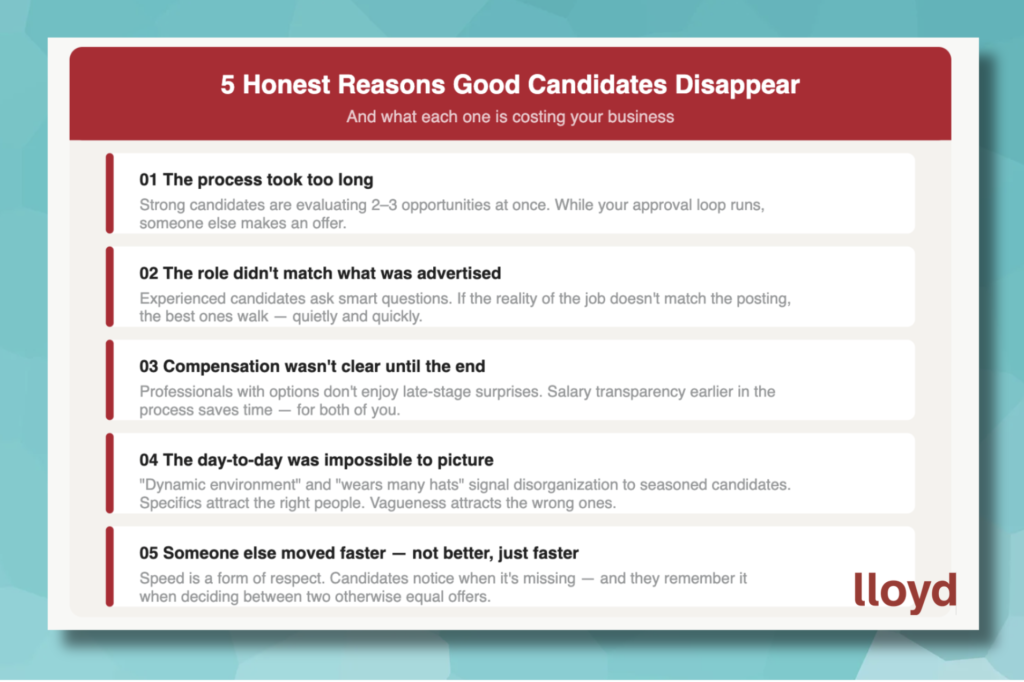
Thing 3: Treat your hiring process like it’s competing for attention — because it is
The average time to fill a professional role has stretched to over 44 days, according to the SHRM 2025 Talent Acquisition Benchmarking Report. For large companies with structured HR teams, that’s a process problem to solve. For a small business, it’s usually just the reality of running a company while trying to hire at the same time — things stall because everyone is already at capacity.

The catch is that the candidates you most want aren’t waiting 44 days. They’re evaluating two or three opportunities simultaneously and forming opinions about your company from the very first interaction. A slow response after an interview, a scheduling process that requires four emails, an offer that takes two weeks to materialize — all of it signals something about how your business operates.
The fix: decide in advance what your process looks like. How many interviews? Who’s involved and when? What does the offer timeline look like? When the search is being managed by a staffing partner whose job it is to keep things moving — following up, scheduling, keeping candidates warm — the process doesn’t stall the way it does when it’s competing with everything else on your plate.
Thing 4: Get specific about what you actually need — not just what the title suggests
Five years ago, the hardest roles to fill at most small businesses were specialized technical ones — a particular software skill, a niche certification, something genuinely rare. That’s still true. But there’s a new category of hard-to-fill that most owners didn’t see coming: roles that require both technical competence and strong judgment.
The accounting manager who can also communicate clearly with a non-finance CEO. The marketing specialist who understands data well enough to know whether a campaign is actually working beyond its creative appeal. The office manager who handles operations, HR questions, vendor relationships, and a dozen other things that never appeared in any job description ever written. These roles are hard to fill because the combination of skills doesn’t show up neatly on a resume — and they’re the roles where a bad hire costs the most.
The demand for this kind of hybrid, judgment-intensive talent has grown sharply. According to the ASA/LinkedIn State of Staffing & Search Report, professional roles requiring both technical skill and strong interpersonal judgment have seen the sharpest increase in hiring demand among businesses of all sizes. The supply hasn’t kept up.
The fix: define the role around outcomes, not tasks. What does this person actually need to accomplish in the first six months? What decisions will they make? Who do they need to influence? Those answers attract a very different — and better — candidate than a list of software proficiencies and years of experience.
The common thread running through all four
None of these four things is especially complicated on its own. The challenge for most business owners is that hiring competes with everything else — client work, operations, revenue, the fifteen other things that needed attention yesterday. When hiring gets squeezed into the margins of an already full week, it tends to default to the path of least resistance: post the job, take what comes in, make the best decision you can, and hope it works out.
That’s not a hiring strategy. It’s a coin flip with overhead attached.
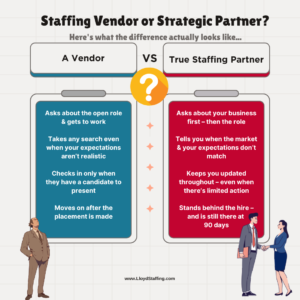
What changes the outcome isn’t a better job board or a fancier interview process. It’s having a staffing partner who makes finding good employees for your small business their full-time job — someone who knows your business well enough to know what “good” actually looks like, who’s already in conversation with the candidates you can’t reach on your own, and who keeps the process moving while you run your company.
That’s the difference between hiring as a distraction and hiring as an advantage.
And in a market where the best people have real options, that difference shows up directly in the quality of the team you build.
For more than 50 years, Lloyd Staffing has worked with SMBs regionally and nationally to place finance, accounting, technology, marketing, supply chain and administrative professionals — with exactly this kind of partnership in mind. If you’ve settled for less, it’s worth knowing what a better relationship looks like.
*************
Lloyd Staffing – FIND TALENT
Start a conversation with a member of the Lloyd leadership team.
Written by Nancy Schuman, CSP, the former Chief Communications Officer for LLoyd Staffing.
A recruitment and career specialist, Nancy has more than 40 years in the staffing industry – three decades with Lloyd. Now semi-retired, she remains an advocate for career education and has advised thousands of candidates on their resumes and job searches. A former Careers columnist for a large weekly Long Island newspaper, Nancy has written 11 popular books for job seekers and business professionals. You can find her Author’s page and books on Amazon. She continues to blog for Lloyd and coach job seekers at all levels, offering advice for today’s competitive workplace.

Related Workforce in Transition Blogs for SMB Hiring: