

Thoughtful, flexible hiring approaches are helping SMBs stay productive, competitive, and prepared — without overcommitting.
The Market Isn’t Frozen — It’s Just Thinking
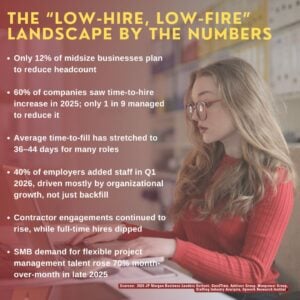
The 2026 hiring market has a name: economists at Indeed call it a “low-hire, low-fire” environment. Employers aren’t contracting — but they aren’t expanding either. According to JPMorgan’s 2026 Business Leaders Outlook, only 12% of midsize businesses plan to reduce headcount this year. The problem isn’t decline. It’s hesitation.
For SMB leaders, the tension is familiar: you still need talent — but you don’t want to overcommit. That’s precisely where today’s hiring strategies for SMBs matter most. This isn’t about pulling back — it’s about moving forward with more precision.
1. Shift from Headcount Growth to Targeted Talent
Not long ago, hiring was driven by urgency. Today, employers are asking sharper questions: Is this a permanent role or a project need? What skills will actually move the business forward?
Economic pressures — tariffs, inflation, global volatility — have encouraged a more deliberate approach. Many organizations are now focusing on targeted expertise tied to specific outcomes, rather than broad headcount growth. That shift is redefining hiring strategies for SMBs across industries.
2. Don’t Let “Wait and See” Quietly Hold You Back
It’s natural to pause in uncertain conditions. But hiring freezes carry real costs that rarely appear on a balance sheet:
- Projects slow and deadlines slip
- Existing teams absorb unsustainable strain
- Competitors who stay active gain ground
GoodTime’s 2026 Hiring Statistics report found that 90% of companies missed their hiring goals last year — and one in three missed by a wide margin. Rather than stepping back entirely, many businesses are turning to flexible staffing solutions that maintain momentum while managing financial risk.
3. Embrace Contract Talent — Not as a Stopgap, But as a Strategy
One of the most significant shifts in hiring strategies for SMBs is the evolution of contract talent — from a fallback option to a deliberate workforce tool. Between 2023 and 2024, contractor engagements rose 46% while traditional full-time hires declined 2% (Staffing Industry Analysts). That’s not a trend — it’s a structural shift.
Organizations are turning to contract-to-hire roles, project-based specialists, and interim leadership to:
- Address immediate needs without permanent overhead
- Evaluate real-world performance before committing
- Maintain flexibility as business conditions evolve
Today’s contract talent model is more intentional than its predecessors. Rather than simply filling gaps, it gives employers performance data that no interview can produce — a meaningful advantage in a cautious market.
4. Rethink “Try Before You Hire” — It’s More Relevant Than Ever
There’s a perception that contract-to-hire models faded during the pandemic hiring surge, when employers prioritized speed and candidates had their pick of offers. That moment has passed.
Today’s version of this approach is more structured and more strategic. The underlying question has evolved from “Can this person do the job?” to “Is this the right long-term fit for where we’re heading?”
With the U.S. staffing market valued at $188.73 billion in 2024 and projected to grow 5% in 2026 (Staffing Industry Analysts), the infrastructure supporting flexible staffing solutions has never been more mature. For SMBs weighing every hire carefully, this model offers a practical way to balance progress with prudence.
5. Cut Through the Noise in a Noisier Talent Market
The rise of AI-assisted applications has dramatically increased applicant volume — but not candidate quality. GoodTime’s research identifies fraudulent or AI-generated candidates as the #1 threat facing hiring teams in 2026. Hiring managers are reviewing more resumes than ever while finding fewer strong matches.
This makes screening and evaluation a more critical capability than ever before. A well-connected staffing partner can help filter that noise, focusing attention on candidates who bring both the skills and the context the role demands. In today’s environment, effective hiring strategies for SMBs aren’t about access to applicants — they’re about identifying the right ones efficiently.
6. Lean Into Specialization
As hiring becomes more targeted, generalist approaches are losing ground. Organizations are increasingly looking for industry-specific experience, skills aligned to evolving business needs, and recruiters who understand the nuances of particular roles.
One in four companies has already removed degree requirements for certain positions (Addison Group), broadening the talent pool while placing greater emphasis on demonstrated skills. For SMBs, a staffing partner with deep sector expertise can provide a clearer line of sight to the right talent — and a meaningful difference in both speed and quality of hire. That’s precisely the kind of specialized support Lloyd Staffing brings to SMB clients across industries, connecting businesses with contract and permanent talent that matches both the role and the moment.
7. Hire for Human Skills That AI Can’t Replace
AI continues to reshape the workforce conversation — but its impact is more nuanced than simple job replacement. According to Gusto’s analysis of 400,000+ small businesses, the share of hires with AI in their job title has grown eightfold since 2019 — and critically, 95% of small businesses regularly using AI are not cutting headcount. AI is expanding capability, not eliminating it.
As a result, hiring strategies for SMBs are increasingly focused on candidates who can work alongside technology while bringing the skills it cannot replicate: critical thinking, judgment, communication, and adaptability. These are the qualities that move a business forward — regardless of what the market is doing.

What SMBs Should Focus on Right Now
The most effective hiring strategies for SMBs in today’s environment share a common thread: intentionality. Rather than reacting to market conditions, leading organizations are adjusting their strategies to align with them — using a mix of hiring models, staying close to market data, and making decisions with both caution and confidence.
In practical terms, that means staying flexible enough to use contract talent when the need is immediate, focused on roles tied directly to business outcomes, informed by real market data on compensation and availability, selective about quality over volume, and balanced between short-term needs and long-term goals.
That combination allows SMBs to keep moving forward — even when the path isn’t entirely clear.
Firms with deep market knowledge and established networks are particularly well-positioned to help SMBs navigate this environment. A trusted staffing partner brings more than candidates — they bring intelligence about compensation trends, talent availability, and role fit that helps employers make decisions they can stand behind.
At Lloyd Staffing, we work alongside SMBs every day — bringing the market intelligence, specialized networks, and flexible hiring models that help businesses make confident talent decisions, even in uncertain times. Learn how we can support your hiring strategy.
Final Thought: The Forest Isn’t Still — It’s Just Quiet
There’s a moment in the forest — just before a shift — when everything feels still. No wind. No movement. But beneath the surface, roots are growing, pressure is building, and change is coming.
That’s the hiring market for SMBs right now. It’s not stalled. It’s preparing.
The organizations that stay thoughtful, flexible, and engaged — with the right flexible staffing solutions and the right partners — won’t just react when the market shifts. They’ll already be moving when the wind picks up.
************************************
Are you in need of hiring support?
Let us help you find the right person for your role. Hire Now.
Are you working, but unsatisfied and ready for a new role?
Visit our Job Board to apply for one of our employment opportunities.
************************************
ABOUT THE AUTHOR

Nancy Schuman, CSP is the former Chief Commuications Officer for LLoyd Staffing.
A recruitment and career specialist, Nancy has more than 40 years in the staffing industry – 27 of them with Lloyd. Now semi-retired, she remains an advocate for career education; she has advised thousands of candidates on their resumes and job searches while also serving as the Careers columnist for a large weekly Long Island newspaper. Nancy has written 11 popular books for job seekers and business professionals. You can find her Author’s page and books on Amazon. She continues to blog for Lloyd and coach job seekers at all levels, offering advice for today’s competitive workplace.