
The Workforce in Transition: A 4-Part Series from Lloyd – Part 1

Not Using a Contingent Workforce Strategy? Your Hiring Playbook Is Out of Date!
This has been the model for traditional hiring: your organization has a need. You write a job description. You interview six people, pick the best one, make them an offer, and bring them on full-time. Clean. Committed. Done.
This is also the version that’s becoming a liability.
Not because full-time hiring is dead — it isn’t. But because treating it as the only option, the default answer to every talent question, is costing businesses more than they realize.
• In speed.
• In overhead.
• In the gap between when you need someone and when that person is actually productive.
The businesses that are outmaneuvering their competition right now tend to share one quiet advantage: they stopped hiring by habit. They hire by design. And for a growing number of them, that means building a contingent workforce strategy into their operations the same way they’d build anything else that matters — intentionally, with thought about what they actually need and when.
The problem with always going permanent

Think about the last time your business hit a shift. Perhaps it was a new client… product launch… a market opportunity you didn’t entirely see coming. The question wasn’t whether you needed more talent. It was how fast you could get it — and whether you could afford to carry that headcount if the opportunity didn’t pan out the way you hoped.
Full-time hiring is a long bet. You’re committing to salary, benefits, and the organizational weight of a permanent employee before you know whether the need is permanent. Sometimes that bet is exactly right. But sometimes what you actually need is a specialist for six months, or a project lead for a product launch, or someone who can run a function while you figure out whether it belongs in-house at all.
For those moments, the traditional model doesn’t just slow you down. It makes the decision harder than it needs to be.
What the smartest SMBs have figured out
The labor market has recalibrated. The frenzied hiring of 2021 and 2022 is behind us. What’s replaced it is more deliberate — on both sides. Employers are more selective. Workers, especially experienced ones, have more options and more clarity about what they want from an engagement.
In that environment, the companies that move decisively win the talent they want. The ones still running six-week interview processes for roles that could be filled by a contract professional in two weeks are losing ground they don’t always notice they’ve lost.
Speed matters. Flexibility matters. And having a workforce model that gives you both — without sacrificing quality — is no longer a nice-to-have – it’s must.
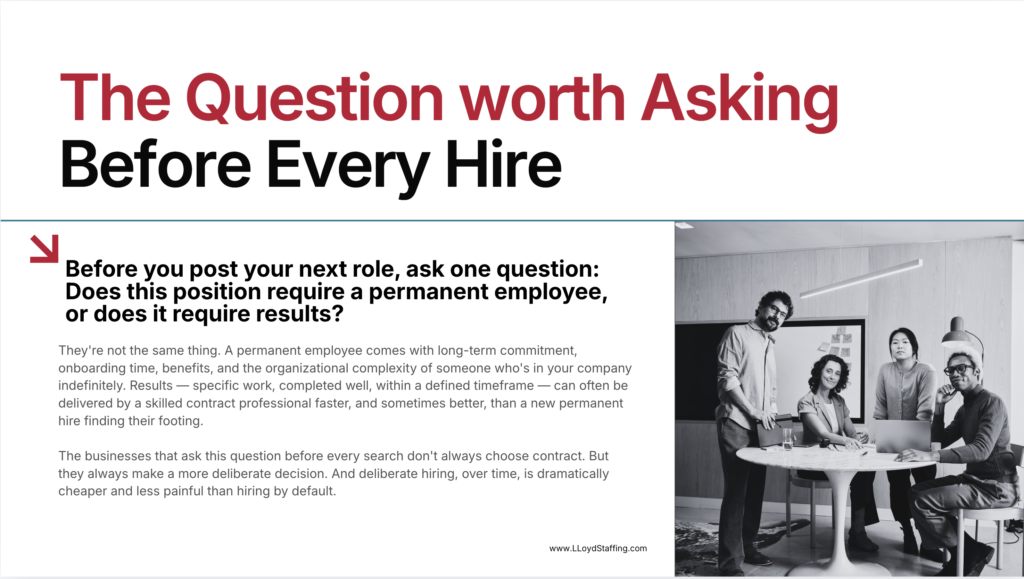
Learn more about the latest insights from SHRM’s 2026 Talent Trends, which explores the current recruitment and hiring landscape and the key trends shaping organizations’ talent strategies.
Come back for next week’s Lloyd blog:
Workforce in Transition, Part 2: 5 Costly Mistakes SMBs Make with Contract-to-Hire Staffing in 2026
*********
Lloyd offers the following practice areas as resources for Contingent Talent.

If you are an employer ready to have a conversation about exploring a contingent workforce strategy, we welcome hearing from you. REQUEST TALENT
Written by Nancy Schuman, CSP, the former Chief Commuications Officer for LLoyd Staffing.
A recruitment and career specialist, Nancy has more than 40 years in the staffing industry – three decades with Lloyd. Now semi-retired, she remains an advocate for career education and has advised thousands of candidates on their resumes and job searches. A former Careers columnist for a large weekly Long Island newspaper, Nancy has written 11 popular books for job seekers and business professionals. You can find her Author’s page and books on Amazon. She continues to blog for Lloyd and coach job seekers at all levels, offering advice for today’s competitive workplace.